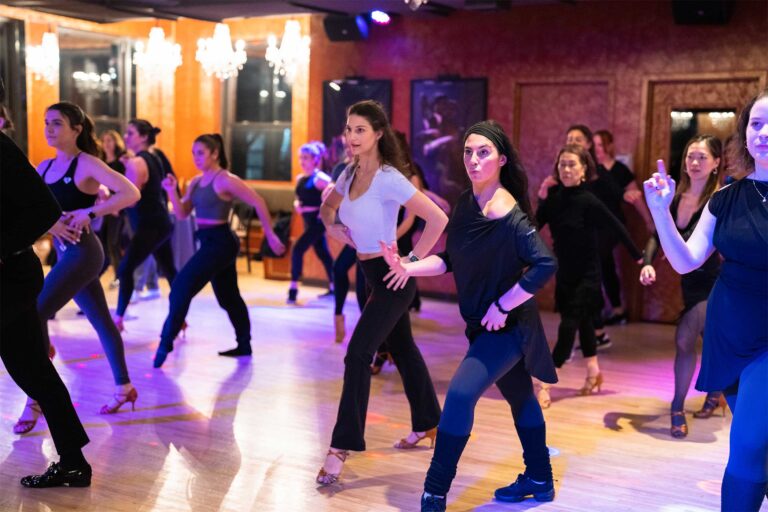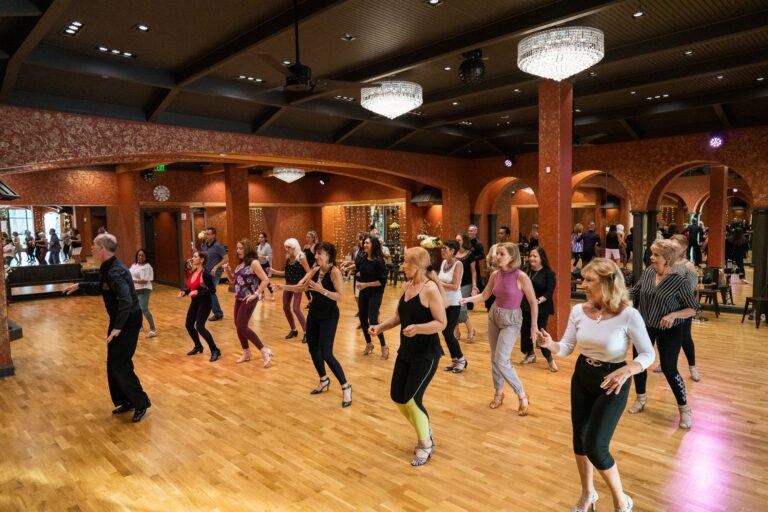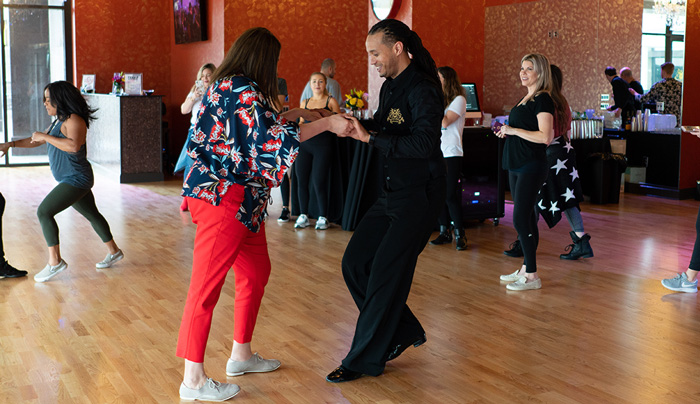
If you feel like you have two left feet, don’t worry. The truth is, anyone who can walk can easily learn how to dance salsa with just a little patience and the right breakdown. Salsa isn’t about complex acrobatics or lightning-fast spins when you’re just starting out; it’s about rhythm, connection, and having fun on the dance floor.
By the end of this guide, you will be able to confidently step onto the floor, hear the rhythm of almost any slow salsa track, and execute the fundamental basic steps without fear of embarrassing yourself. Let’s shake off the nerves and get moving!
Understanding Salsa Rhythm and Timing (The 8-Count Beat)
Before you move your feet, you have to train your ears. Salsa music is built on a rich tapestry of African and Caribbean rhythms, heavily anchored by a structural pattern called the clave rhythm. To dance salsa successfully, you don’t need a degree in musicology—you just need to count to 8.
Salsa is danced over an 8-count musical phrase. However, you only take 6 steps during those 8 counts.
The Golden Rule of Salsa Timing: You step on counts 1, 2, 3, and counts 5, 6, 7. Counts 4 and 8 are your designated pauses.
To make this incredibly simple, forget complex musical theory and think of the rhythm as a steady pattern of steps and freezes:
-
Count 1: Step (Quick)
-
Count 2: Step (Quick)
-
Count 3: Step (Slow / Hold)
-
Count 4: Pause/Hold your weight
-
Count 5: Step (Quick)
-
Count 6: Step (Quick)
-
Count 7: Step (Slow / Hold)
-
Count 8: Pause/Hold your weight
Think of it as a rhythmic loop: Quick, Quick, Slow… Quick, Quick, Slow. During counts 4 and 8, your body naturally slows down or pauses its momentum, allowing you to transition smoothly into the next set of steps. Developing this internal sense of musicality and practicing this simple rhythm practice away from the dance floor will instantly give you an edge over other beginners.
The Basic Salsa Step: Footwork Breakdown
Now that your brain understands the timing counts, let’s bring that rhythm down to your feet. The fundamental movement of salsa is a conversational exchange between two people. To make this happen seamlessly, one person acts as the Leader and the other acts as the Follower.
No matter which role you choose, always remember to stay relaxed on the ball of the foot with your knees slightly bent. This keeps your weight mobile and athletic.
Leader Steps (Typically Men)
As the leader, you are responsible for initiating the movement and guiding the direction of the dance. Your starting position begins with your feet together in a neutral stance.
-
Count 1: Take a small step forward with your left foot forward, shifting your weight onto it.
-
Count 2: Step in place with your right foot, executing a quick weight shift back to the right side.
-
Count 3: Bring your left foot backward, placing it right next to your right foot.
-
Count 4: Hold your position. This is your pause beat. Your weight should now be balanced on your left foot.
-
Count 5: Take a small step backward with your right foot.
-
Count 6: Step in place with your left foot, shifting your weight forward.
-
Count 7: Bring your right foot forward, returning it to the starting position next to your left foot.
-
Count 8: Hold your position. This is your second pause beat. Your weight is balanced and ready to repeat the cycle from Count 1.
Follower Steps (Typically Women)
As the follower, your job is to respond to the signals of the leader. Because salsa is a mirrored dance, you will create a perfect harmony by doing the exact opposite of the leader.
-
Count 1: Take a small step backward with your right foot backward, shifting your weight onto it.
-
Count 2: Step in place with your left foot, transferring your weight back to the front.
-
Count 3: Bring your right foot forward, returning it next to your left foot.
-
Count 4: Hold your position. This is your pause beat. Your weight is now balanced on your right foot.
-
Count 5: Take a small step forward with your left foot.
-
Count 6: Step in place with your right foot, shifting your weight backward.
-
Count 7: Bring your left foot backward, returning it to the starting position next to your right foot.
-
Count 8: Hold your position. This is your second pause beat. Your weight is balanced and ready to mirror the leader on Count 1.
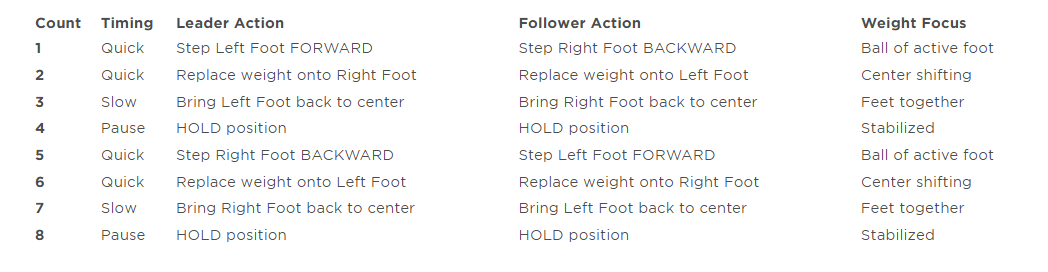
Quick Reference: Leader vs. Follower Matrix
Click in the image below:
Partner Work: Positioning and Connection
Once you can execute the salsa basic step independently, it’s time to team up with a dance partner. A great connection on the dance floor relies entirely on a physical framework called the frame, a structural connection held through the arms and upper body that allows partners to communicate without talking.
There are two primary positions you will navigate during social dancing:
The Closed Position
This is the intimate, standard frame used in most styles of ballroom dancing and Latin club dancing.
-
The Leader: Place your right hand gently on the lower part of the follower’s left shoulder blade. Your left arm should be raised to about chest height, holding your elbow out to create a strong, supportive frame.
-
The Follower: Rest your left hand lightly on the leader’s right shoulder or upper arm. Place your right hand inside the leader’s left hand.
-
The Connection: Maintain a subtle, constant resistance in your arms. Think of it like a light spring: if the leader presses forward slightly, the follower responds; if the leader pulls back, the follower moves with them. Keep your arm placement firm but elastic—never stiff or completely limp.
The Open Position
This position offers more freedom and is usually used to transition into turns or a cross-body lead.
-
Both partners drop the close body contact and step slightly apart.
-
The leader offers their hands palms up at waist height, and the follower places their hands palms down inside the leader’s grip (hand hold). Keep the elbows bent and close to your ribs to maintain a strong frame.
Salsa Styles: On1 (LA Style) vs. On2 (New York Style)

As you dive deeper into the salsa community, you will inevitably hear people talk about dancing “On1” or “On2.” While there are many regional variants across Cuba, Puerto Rico, and Colombia, these two structural timing systems dominate global nightclubs.
- On1 Salsa (LA Style): This is the most common style taught worldwide and the style we focus on in this guide. “On1” means that the most explosive, dynamic movement happens directly on the very first beat of the musical phrase (Count 1). It is highly linear, theatrical, and exceptionally easy for beginners to hear and execute.
- On2 Salsa (New York Style): Championed by modern mambo legends, On2 dancers break or change direction on the second beat of the musical phrase (Count 2). It syncopates deeply with the underlying percussion and instruments like the congas.
For an absolute beginner visiting a night club or starting out with a dance instructor, mastering On1 is your fastest path to feeling confident on any dance floor in the world.
5 Common Salsa Mistakes Beginners Make (and How to Fix Them)
Even with the best intentions, our dance experts notice new students falling into the same structural traps. Avoid these five common pitfalls to look like a seasoned pro much faster:
- Taking Giant Steps: When nerves kick in, beginners tend to take massive strides across the floor. This destroys your balance and throws you completely off the rhythm. Keep your steps compact—they should be no larger than the natural length of your own foot.
- Staring at Your Feet: Looking down sends a signal of panic and ruins your body posture. Your feet will do the work if you trust them. Keep your chin up, make eye contact with your partner, and smile.
- “Spaghetti” Arms: If your arms are completely loose and noodle-like, your partner cannot feel where you are going. Keep your elbows bent, hold your frame, and maintain a gentle tension throughout your upper body.
- Rushing the Pause (Skipping Counts 4 and 8): The absolute hardest part for beginners is doing nothing. Do not skip the pause beats. Let your body absorb the slow count so you don’t end up dancing ahead of the music.
- Bouncing the Upper Body: Salsa movement is generated from the hips and the lower body, not by bouncing up and down from your head and shoulders. Keep your head level as if you are balancing a book on it, and let your hips naturally absorb the weight transfers.
Frequently Asked Questions (FAQ)
What foot does a woman start with in salsa?
In traditional partner configurations, the woman (acting as the follower) always begins the basic step by stepping backward with her right foot on Count 1.
How long does it take to learn basic salsa?
With focused practice, most absolute beginners can comfortably master the 8-count basic step, correct posture, and simple partner connections within 4 to 6 weeks of taking weekly classes.
Can you dance salsa without a partner?
Absolutely! Dancing salsa solo is a major component of the genre known as “shines.” Practicing your footwork, timing, and body movement independently is highly recommended to build balance before adding a partner into the mix.
Ready to Feel the Rhythm?
Learning how to dance salsa comes down to three simple, non-negotiable pillars: actively listening to the music, keeping your steps small, and maintaining a proud, upright posture.
Find the Best Salsa Classes Near You
Ready to trade your “two left feet” for effortless rhythm and confidence? At Dance With Me, we break down salsa into fun, simple steps so you can feel comfortable on any dance floor from day one. Whether you want to master the social dance scene, prepare for an upcoming event, or experience an exciting new hobby with private lessons or group classes, our world-class instructors are ready to guide you. No partner or prior experience is ever required!
Select your closest Dance With Me studio below to view local schedules and claim your introductory offer