Stepping onto a Latin dance floor can feel intimidating, but learning how to dance Bachata is your ultimate passport to confidence. Originating in the rural towns of the Dominican Republic, Bachata has grown into a global social dancing phenomenon.
The secret to its massive popularity? It is incredibly accessible. Unlike complex dances that require years of training, Bachata is built on an intuitive rhythm that you can easily learn at home. Within just 10 minutes, you will understand the fundamental structure needed to step comfortably onto any dance floor.
Whether your goal is to dance socially at a local club, feel confident at weddings, or simply enjoy a new hobby, this guide will take you from absolute scratch to a smooth, rhythmic dancer. Let’s break down the timing, solo footwork, natural styling, and partner connections that make Bachata so captivating.
Understanding the Bachata Rhythm and Timing
Before moving your feet, you must train your ears. Every great dancer listens to the music first and moves second. Bachata music has a distinct, driving rhythm that tells your body exactly when and where to step.
How to Count Bachata Music (The 8-Count Pattern)
Bachata is written in a standard 4/4 time signature, meaning there are 4 beats to a musical measure. However, social dancing happens across a full 8-count cycle—combining two bars of music into one complete phrase.
Think of your dance rhythm as a continuous loop of counts 1 through 8.
- Counts 1, 2, and 3 are your active traveling steps.
- Count 4 is your stationary pause, or “tap.”
- Counts 5, 6, and 7 are your active returning steps.
- Count 8 is your final stationary pause and “tap.”
This simple formula—three steps followed by a tap—repeats continuously throughout the entire song.
Finding the Beat: The Role of the Bongo and Güira
To find the beat in a modern Bachata track by artists like Prince Royce or Romeo Santos, or traditional classics by Anthony Santos, you must listen to the percussion section. The two most important instruments for a dancer are the bongo drums and the güira (a metal percussion scraper).
The güira plays a continuous, scraping pattern that keeps the underlying tempo steady. The bongo drums provide the heavy rhythmic accents. Pay close attention to the bongo: on the 4th and 8th beats of the musical phrase, you will hear a distinct, sharp, and slightly higher-pitched striking sound. This specific drum hit coincides perfectly with your “tap” step, serving as an audio cue that anchors your timing to the music.
The Foundational Footwork: Solo Step Breakdown
Now that you can hear the rhythm, let’s bring it down to your feet. Practice these three foundational variations on your kitchen floor or living room rug until you no longer need to look down at your toes.
The Side-to-Side Basic Step
This is the quintessential Latin dance pattern that every beginner learns first. It moves you laterally across the floor.
- The Starting Stance (Preparation): Stand with your feet completely together, knees slightly bent and relaxed. Keep your upper torso upright and steady. Leads prepare to move left; Follows prepare to move right.
- The Lateral Departure (Counts 1–3): On Beat 1, take a controlled side step out to the left with your left foot. On Beat 2, bring your right foot in to close the gap, placing it right next to your left. On Beat 3, take one more side step to the left with your left foot.
- The Touch & Hip Lift (Count 4): On Beat 4, bring your right foot next to your left, but do not shift your weight to it. Touch the floor lightly with the ball of your foot while naturally lifting your right hip.
- The Return Journey (Counts 5–8): On Beat 5, step out to the right with your right foot (which is entirely free because there was no weight placed on it during the tap). Bring your left foot in to meet it on Beat 6, step to the right side again on Beat 7, and finish with a light left-foot touch and hip lift on Beat 8.
⚠️ CAUTION: Do not shift your body weight onto your foot during the 4th or 8th beat tap. If you accidentally step fully onto that foot, your weight will be locked, your feet will be backwards, and you will stumble when trying to change directions for the return journey.
The Forward and Back Variation
Once you can glide side-to-side, it is time to open up the dance floor by moving linearly. The forward and back basic uses the exact same 8-count timing, but changes your directional plane.
- Count 1: Step forward with your left foot.
- Count 2: Bring your right foot forward, closing it next to your left.
- Count 3: Step forward one more time with your left foot.
- Count 4: Tap your right foot next to your left, popping your right hip.
- Count 5: Step backward with your right foot.
- Count 6: Bring your left foot backward, closing it next to your right.
- Count 7: Step backward one more time with your right foot.
- Count 8: Tap your left foot next to your right, popping your left hip.
⚠️ CAUTION: Keep your steps small. Taking massive strides forward or backward will break your posture, throw off your balance, and make it impossible to stay synchronized with a partner.
The Box Step (The Traditional Dominican Secret)
The Box Step is an authentic, traditional Dominican footwork pattern. Instead of moving purely left-to-right or front-to-back, you trace a square shape on the floor. This step is highly valued in social dancing for its compact nature and rhythmic syncopation.
- Count 1: Step your left foot out to the left side.
- Count 2: Bring your right foot close, stepping it right next to your left.
- Count 3: Step your left foot straight forward.
- Count 4: Tap your right foot next to your left (no weight shift).
- Count 5: Step your right foot out to the right side.
- Count 6: Bring your left foot close, stepping it right next to your right.
- Count 7: Step your right foot straight backward.
- Count 8: Tap your left foot next to your right (no weight shift).
Mastering the Hip Movement and Styling
The distinctive look of Bachata comes from its fluid, hypnotic hip movement. A common error among beginners is trying to force an aggressive, muscular “hip pop” on counts 4 and 8. This looks rigid and unnatural.
True Latin dance styling relies entirely on a mechanical weight transfer. The hip motion is a natural consequence of bending your knees and shifting your body weight across a straight leg.
The Weight Transfer Mechanics
As you take a step on Count 1, you bend your knee slightly as your foot makes contact with the floor. As you transition your full body weight over that foot, you slowly straighten that leg. The natural mechanical result of straightening your leg causes that corresponding hip to push outward and upward.
When you arrive at the tap on Count 4, your standing leg (left) is straight, which naturally extends your left hip outward. The tapping foot (right) has a bent knee and carries no weight, allowing that right hip to drop down. This contrast creates the illusion of a deliberate hip pop, but it is actually just pure, relaxed physics. Keep your upper upper body and shoulders completely level to isolate this movement beautifully below the waist.
Transitioning to Partner Work: Holds and Connection
Bachata is fundamentally a conversation between two people. To ensure a smooth dance without stepped-on toes or mixed signals, you must build a secure, comfortable dance frame.
A proper dance frame requires both partners to maintain a slight, positive resistance in their arms. This tone acts as a communication wire; when the leader moves their torso, the follower can feel the direction instantly through the hands without the leader having to pull or push.
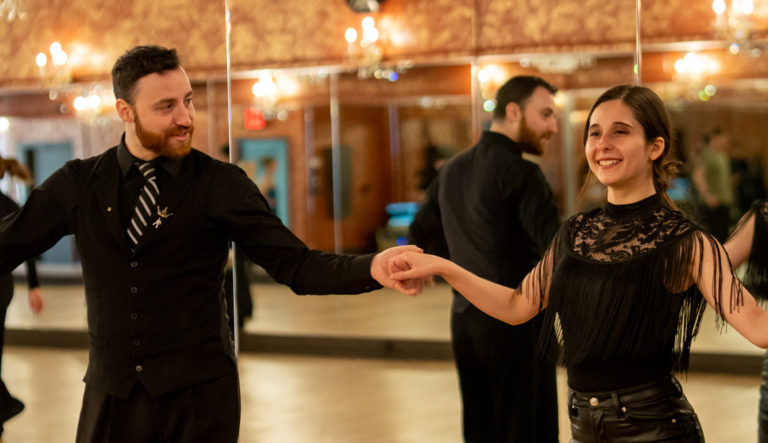
The Open Position (Best for Beginners)
This position provides plenty of personal space and is excellent for learning basic turns and footwork variations.
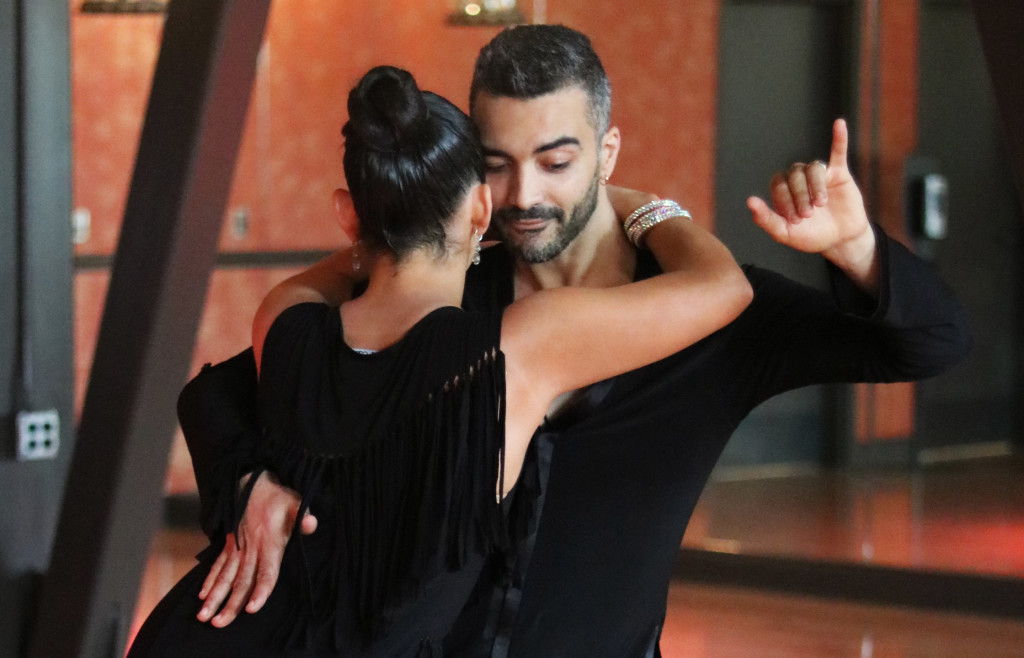
The Closed Position (The Traditional Hold)
The closed position offers a much tighter connection, ideal for navigating crowded social dance floors and executing subtle body isolations.
- The Leader’s Placement: The leader places their right hand firmly on the follower’s left shoulder blade to guide their movement. The leader’s left hand holds the follower’s right hand out to the side at eye level.
- The Follower’s Placement: The follower rests their left arm gently along the top of the leader’s right shoulder and upper arm, keeping their elbow light.
By mirroring each other’s feet—Leads stepping left, Follows stepping right—you move in perfect harmony without ever colliding.
Dominican vs. Sensual Bachata: Which One Are You Learning?
As you explore social dancing events, festivals, and video tutorials online, you will notice that Bachata has evolved into two primary, distinct branches. Knowing the difference helps you understand the music and styling you prefer.
Traditional / Dominican Bachata
This is the authentic root of the dance, straight from the Dominican Republic. It is highly energetic, fast-paced, and footwork-dominant. Instead of simple side-to-side motions, dancers utilize intricate syncopated steps, box steps, and free-form playfulness. It is danced in a close, rotational frame and focuses heavily on interacting directly with the rhythms of the bongo and guitar strings.
Sensual Bachata
Developed in Spain in the early 2000s, this modern adaptation has taken over international festivals. Sensual Bachata slows down the movement and shifts the focus away from complex footwork toward dramatic body isolations, vertical body waves, and structural dips. Dancers use a flexible frame to execute fluid, undulating movements that interpret the emotional melodies and smooth vocals of modern remix tracks.
Troubleshooting & Common Mistakes
Even with careful practice, beginners often run into a few common roadblocks. Use this quick reference guide to diagnose and correct your technique instantly.
Why do my feet feel backwards on the return step?
- The Cause: You are shifting your full weight onto your foot during the 4th or 8th beat tap.
- The Fix: Ensure your tapping foot remains light. You should be able to instantly lift it off the floor at any second without losing your balance.
I keep losing the rhythm of the music. What should I do?
- The Cause: You are trying to count numbers in your head instead of listening to the physical instruments.
- The Fix: Stop moving your feet for a moment. Listen closely to the track until you isolate the sharp, metallic slap of the güira or the heavy thud of the bongo on the 4th beat. Tap your hand against your leg on that beat, then restart your footwork.
How do I prevent stepping on my partner’s feet?
- The Cause: Standing completely toe-to-toe or taking steps that are too large.
- The Fix: Offset your standing position slightly to the left so your right foot fits cleanly between your partner’s feet. Keep your steps small—never step wider than the width of your own shoulders.
Summary and Next Steps
Mastering the beautiful art of Bachata comes down to a simple, universal formula:
- 3 Steps + 1 Tap: Travel for three counts, tap and lift your hip on the fourth.
- Listen for the Bongo: Let the percussion section dictate your weight shifts.
- Relax Your Knees: Fluid hip movement comes from natural weight transfers, not forced muscle tension.
- Maintain Your Frame: Keep a light, supportive arm connection to communicate clearly with your partner.
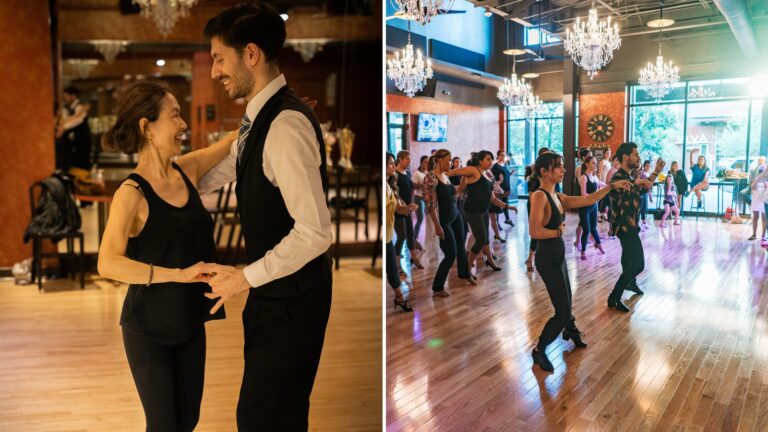
Learning the basic steps at home is a fantastic way to start, but nothing compares to the magic, community, and fast-paced progress of a real dance floor.
Find the Best Bachata Classes Near You
Select your closest Dance With Me studio below to claim your introductory lesson and start your dancing journey today!
Frequently Asked Questions
Is Bachata easier to learn than Salsa?
Yes, most beginners find Bachata significantly easier to learn than Salsa. Salsa utilizes a quick-quick-slow rhythm across a 3-step sequence with a silent pause, often executed at a very fast tempo with complex turns. Bachata relies on a highly predictable, continuous 4-beat structure that matches the natural rhythm of walking, making it the perfect gateway Latin dance.
What foot does a leader start with in Bachata?
The leader always starts with their left foot, stepping out laterally to the left side on Count 1. The follower mirrors this movement, starting with their right foot stepping out to their right side.
On what beat do you hip tap in Bachata?
The hip tap occurs cleanly on Count 4 and Count 8 of the musical phrase. This tap coincides with the dominant percussive accents played by the bongo drums.