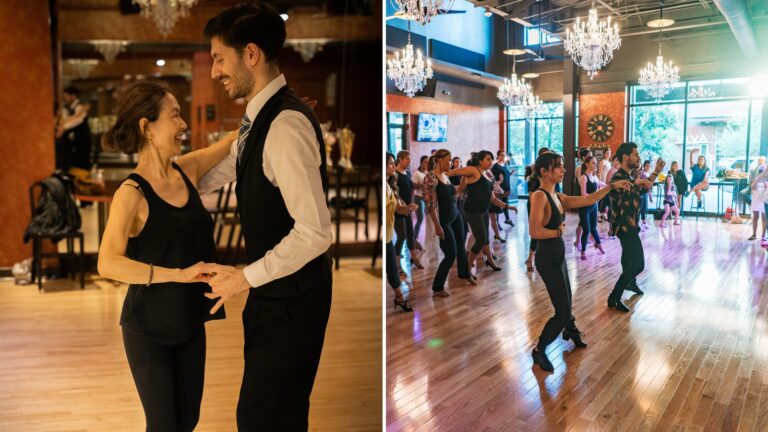
The easiest ballroom dance for beginners is East Coast Swing, followed closely by the Waltz. East Coast Swing uses a six-count basic (triple step, triple step, rock step) that most beginners can dance to a full song in one lesson, and it fits almost any upbeat music. The Waltz is the easiest “classic” ballroom dance: a slow 3/4 box step at 84–90 beats per minute that gives you about two-thirds of a second per step. Rumba, American Foxtrot, Cha-Cha and American Tango round out the six easiest.
Most “easiest ballroom dance” lists just name a few dances and call them simple. This guide does something different: it defines what actually makes a dance easy, ranks the beginner-friendly dances against those criteria, and — just as useful — tells you which popular ballroom dances are not good first choices, even though some lists claim they are.
Key Takeaways
- East Coast Swing is the easiest ballroom dance to become socially useful in, because its six-count basic works with swing, rock ‘n’ roll, pop and country music after a single lesson.
- The Waltz is the easiest traditional ballroom dance, because its slow 3/4 box step gives a beginner roughly 0.7 seconds per step at standard tempo.
- Rumba is the easiest ballroom dance in the Latin family, because its slow tempo leaves time to learn Cuban hip motion without rushing.
- Viennese Waltz, Quickstep, Slow Foxtrot, Paso Doble, Samba and Jive are poor first ballroom dances, because their speed, technique or characterization demands are built for intermediate and advanced dancers.
- A ballroom dance can be easy to start and hard to master at the same time: American Foxtrot’s walking basic is one of the easiest to learn, while International Slow Foxtrot is widely considered the most technically demanding dance in ballroom.
- No partner and no experience are needed to learn any of the easiest ballroom dances, because group classes at most studios rotate partners and private lessons pair students with an instructor.
Not sure where to start? Find the best ballroom classes near you at a Dance With Me studio — a first lesson in any of these six dances is built for complete beginners.
What Is the Easiest Ballroom Dance for Beginners?
East Coast Swing is the easiest ballroom dance for most beginners, and the Waltz is the easiest if you want a traditional, elegant ballroom dance. Both have a short, repeating basic step, a clear beat that’s easy to hear, and a basic you can dance to a whole song after one lesson. Which one is “easiest” for you depends mostly on the music you want to dance to.
Here’s how the six most beginner-friendly ballroom dances compare:
| # | Dance | Time per Step* | Basic Learned In |
|---|---|---|---|
| 1 | East Coast Swing | 0.42 s | 1 lesson |
| 2 | Waltz | 0.67–0.71 s | 1 lesson |
| 3 | Rumba | 0.56–0.58 s | 1–2 lessons |
| 4 | American Foxtrot | 0.50–0.54 s | 1–2 lessons |
| 5 | Cha-Cha | 0.23–0.25 s | 2 lessons |
| 6 | American Tango | 0.45–0.50 s | 1–2 lessons |
*Time per step = the time you have to complete the fastest step in the beginner basic (single-time basic for East Coast Swing), calculated as 60 ÷ BPM × beat value from standard tempos: East Coast Swing 136–144 BPM, Waltz 84–90, Rumba 104–108, Foxtrot 112–120, Cha-Cha 120–128, Tango 120–132. Social dancing is often slower. Calculation by Dance With Me.
The “Time per Step” column is the single best predictor of how rushed a beginner feels. At standard tempo, a waltz step gives you about 0.7 seconds to move your weight; a Quickstep quick step gives you about 0.3 seconds, and a Viennese Waltz step about 0.33. That gap — more than double — is why the Waltz feels calm on day one and the Viennese Waltz feels like a sprint.
What Makes a Ballroom Dance Easy to Learn?
A ballroom dance is easy for beginners when it has a short repeating basic, a slow-to-moderate tempo, a beat that’s easy to hear, little or no special body technique, and a first figure that works on a real dance floor. No official body ranks ballroom dances by difficulty — syllabus organizations like DVIDA and the ISTD define figures and levels, not “easy” lists — so the ranking above uses these five practical criteria.
- Length of the basic. A four- to six-step pattern you can repeat for a whole song (Waltz box, swing basic, rumba box) beats a dance whose basic is long or changes direction constantly.
- Time per step. Slower steps give your brain time to talk to your feet. This is measured directly from tempo (see the table above).
- How easy the beat is to hear. Swing’s strong backbeat and the Waltz’s ONE-two-three are easy to find in music. Syncopated or very fast music is harder.
- Special technique required on day one. Rumba asks for Cuban motion; Tango asks for a staccato, no-rise walk; Samba asks for a bounce action most beginners can’t do yet. The less technique you need just to make the basic look right, the easier the dance.
- Social usefulness. A dance is only “learned” when you can use it. East Coast Swing ranks first partly because you’ll hear music for it at almost every party or wedding.
A common error worth correcting: several beginner guides describe the waltz box step as “four steps.” It’s six — two half-boxes of three steps each (forward, side, close; back, side, close), one step per beat across two bars of 3/4 music.
Which Ballroom Dances Are Easiest to Learn? The 6 Best First Dances
1. East Coast Swing — The Fastest Path to Dancing Socially
East Coast Swing is the easiest ballroom dance to become useful in. The six-count basic — triple step, triple step, rock step — repeats in a small circle and fits swing, rock ‘n’ roll, Motown, pop and even country songs. Many instructors start true beginners on single-time swing (step, step, rock step), which gives you 0.42 seconds per step and removes the faster triples until you’re comfortable.
Easy because: short basic, strong beat, works with a huge range of music. The catch: the triple steps are fast (about 0.2 seconds per step at full tempo), which is why single-time comes first. Full footwork breakdown: basic steps of swing dance. Want to explore the swing family? See our guide to the types of swing dance.
2. Waltz — The Easiest Traditional Ballroom Dance

The Waltz is the dance most people picture when they hear “ballroom,” and it’s the slowest-feeling dance on this list. The box step repeats perfectly, the count (ONE-two-three) is unmistakable, and you get about two-thirds of a second per step. Beginners can add rise and fall gradually rather than on day one.
Easy because: slowest steps of any ballroom dance, simple box pattern, clear count. The catch: looking elegant — rise and fall, sway, a steady frame — takes much longer than learning the steps. Step-by-step guide: how to dance the waltz.
3. Rumba — The Easiest Latin Ballroom Dance
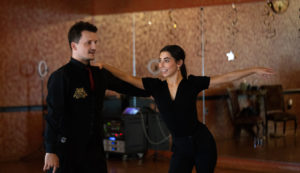
Rumba is the slowest, most forgiving dance in the Latin family. The American Rhythm basic is a box danced to a slow-quick-quick rhythm, and the unhurried tempo gives beginners time to learn Cuban motion — the knee-driven hip action that every Latin ballroom dance uses.
Easy because: slow tempo, compact box basic, romantic music. The catch: the hip action feels unnatural at first. Most students find it clicks around the second or third lesson.
4. American (Social) Foxtrot — The Easiest Dance to Walk Into
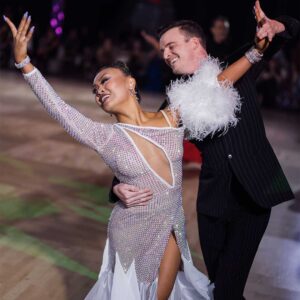
The social or American Foxtrot uses a slow-slow-quick-quick rhythm built on natural walking steps, which is why so many beginners find it intuitive. It’s danced to the jazz standards and big band songs heard at weddings, galas and cruises. Learn more: how to steal the night with the Foxtrot.
Easy because: walking-based steps, comfortable tempo. The catch: this is the American social version. International Slow Foxtrot is a completely different experience (see below).
5. Cha-Cha — The Easiest Upbeat Latin Dance
Cha-Cha is playful, recognizable and danced to a huge range of Latin and pop music. The basic is a rock step followed by the “cha-cha-cha” triple chassé, and its rhythm is easy to hear once someone points it out.
Easy because: fun, recognizable rhythm, music you already know. The catch: the chassé steps are fast — about a quarter of a second each — so Cha-Cha usually takes a lesson longer than Rumba. Guide: how to dance Cha-Cha.
6. American Tango — Easy Steps, Harder Style
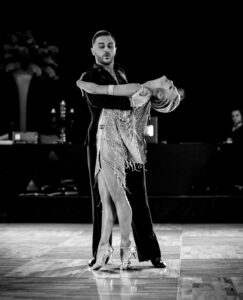
The American Tango basic is a walk: slow, slow, quick, quick, slow. Beginners can learn it in a single lesson. It ranks sixth because the style — staccato timing, no rise and fall, sharp head turns, an offset hold — takes longer to make look like tango. Full guide: how to dance tango.
Easy because: walking basic, steady marching beat. The catch: character and frame take weeks, not minutes.
Honorable mention — Merengue. If you just want the simplest partner dance possible, Merengue is a marching two-step that fits nearly any Latin song. It isn’t one of the four competitive ballroom categories, but it’s taught in most ballroom studios and is often a student’s very first Latin dance.
Which Ballroom Dances Are Hardest for Beginners?
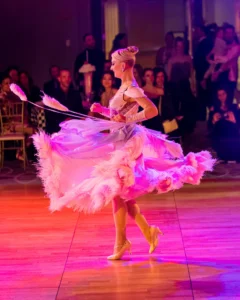
Viennese Waltz, Quickstep, International Slow Foxtrot, Paso Doble, Samba and Jive are the ballroom dances most instructors save for later. Each one is hard for a specific reason — speed, technique or characterization — and starting with them usually means more frustration and slower progress. Some beginner lists include Viennese Waltz and Quickstep as “easy” because their patterns repeat; repetition doesn’t help much when each step arrives in a third of a second.
| Dance | Main Challenge | Learn It After |
|---|---|---|
| Viennese Waltz | Fast, nonstop rotation | Waltz |
| Quickstep | Very fast hops and runs | Foxtrot, Waltz |
| Slow Foxtrot (Int’l) | Advanced control | Waltz, Foxtrot |
| Samba | Bounce technique | Rumba, Cha-Cha |
| Paso Doble | Heavy stylization | Cha-Cha, Rumba |
| Jive | Fast kicks and flicks | East Coast Swing |
Speed is the problem for three of them. At standard tempo, a Viennese Waltz step lasts about 0.33 seconds (174–180 BPM), a Quickstep quick step about 0.3 seconds (200–208 BPM), and a Jive beat 0.33–0.36 seconds (168–184 BPM), compared with roughly 0.7 seconds for a Waltz step. The other three are hard for technique reasons: Slow Foxtrot needs continuous movement in closed hold with no visible weight changes, Samba’s bounce action is a skill of its own that also travels around the floor, and Paso Doble is a stylized, character-driven dance that’s rarely danced socially.
None of these is off-limits forever — they’re simply easier as a second or third dance, once timing and frame are automatic.
Why Can a Ballroom Dance Be Easy to Start but Hard to Master?
Learning a dance’s basic and dancing it well are two different skills, and the gap between them varies a lot from dance to dance. The Foxtrot is the clearest example: the American social Foxtrot is built on walking and is one of the easiest dances to start, while the International Slow Foxtrot — same family, same music style — is widely considered the most technically demanding dance in ballroom.
The same pattern shows up across the list:
- Waltz: easy box step, but smooth rise and fall takes months.
- Tango: easy walking basic, but the staccato, grounded character takes weeks.
- Rumba: easy slow box, but true Cuban motion is a long-term project.
- East Coast Swing: the rare dance that’s both easy to start and quickly satisfying, which is why it ranks first.
For a beginner, this is good news. “Easy to start” is what matters for your first month. Mastery comes from the second dance, the third, and the hours on the floor in between — and timing and frame skills carry over from one dance to the next.
Which Easy Ballroom Dance Should You Learn First?
Pick your first ballroom dance by the music you want to dance to and the occasion you’re preparing for, not just by difficulty. All six dances above are beginner-friendly; the right one is the one you’ll actually use.
- Wedding coming up? Waltz or Foxtrot for a classic first dance; Rumba for a slow, romantic song. See when to start wedding dance lessons for a timeline.
- Want to dance at parties and events? East Coast Swing first, then Cha-Cha.
- Love Latin music? Rumba, then Cha-Cha. If you’re drawn to clubs rather than ballrooms, compare salsa vs. bachata.
- Want classic ballroom elegance? Waltz, then Foxtrot.
- Want a dance with attitude? American Tango.
- Learning as a couple? East Coast Swing and Waltz together cover fast and slow songs between them.
- Thinking about competing someday? Start with Waltz and Cha-Cha — they’re the foundation figures in both the American and International syllabi.
Not sure whether to start with a private lesson or a group class? Read private lessons or group classes: which should beginners choose first?
Find the Best Ballroom Classes Near You
Reading a ranking helps you pick a dance. Learning it takes music, a floor and an instructor who can fix your frame and timing in the first five minutes. Choose a studio below and start with whichever dance sounded most like you — no partner and no experience required.

Frequently Asked Questions
Is ballroom dancing hard to learn for beginners? No — the basic steps of the most beginner-friendly ballroom dances, such as East Coast Swing, Waltz and Rumba, can be danced to a full song after one lesson. What takes longer is quality: frame, timing and technique. Most beginners dance comfortably at a social event within two to three months of weekly lessons.
Is Latin or ballroom dancing easier for beginners? Smooth ballroom dances like Waltz and Foxtrot are usually easier to start because their steps are slower and use natural walking or box patterns. Latin ballroom dances like Rumba and Cha-Cha add Cuban hip motion, which takes a few lessons to feel natural. Rumba is the easiest Latin dance because its slow tempo gives time to learn that hip action.
Which is easier to learn, the waltz or the foxtrot? The Waltz is slightly easier for most beginners because its steps are slower (about 0.7 seconds each at standard tempo) and its box pattern stays in one small area. American social Foxtrot is close behind because it’s built on walking steps. International Slow Foxtrot is much harder than either.
What is the easiest ballroom dance for couples? East Coast Swing and Waltz are the easiest ballroom dances for couples learning together. Between them they cover fast and slow songs, both basics can be learned in one lesson, and both work at weddings and social events. Rumba is a good third choice for slow, romantic music.
Can you learn ballroom dancing at home? You can learn the footwork of an easy ballroom dance at home using videos and solo practice. Leading, following and frame are much harder to learn without feedback, so most beginners combine home practice with at least a few lessons from an instructor who can correct posture and timing early.
What should I learn after my first ballroom dance? Pick a second dance from the other family: if you started with a smooth dance like Waltz, add Rumba or East Coast Swing; if you started with swing or Latin, add Waltz or Foxtrot. Save Viennese Waltz, Quickstep, Samba, Paso Doble and Jive until your basic timing and frame feel automatic.
Ready to try the easiest ballroom dance for you? Find the best ballroom classes near you and book your first lesson at Dance With Me — no partner or experience required.