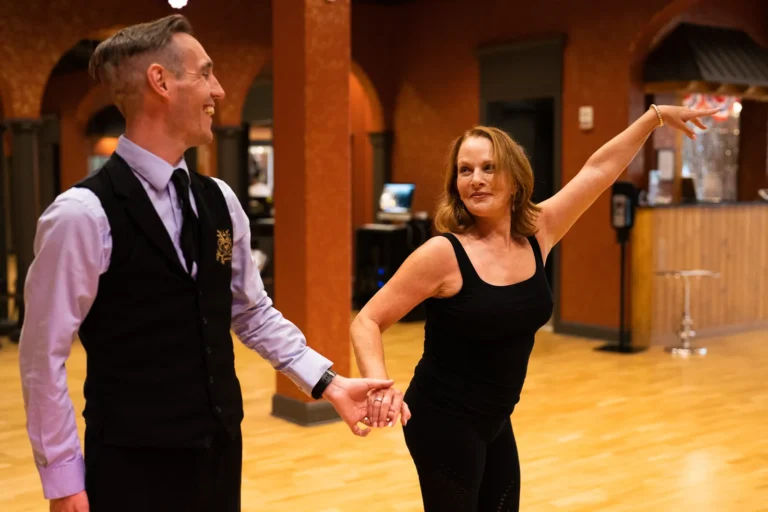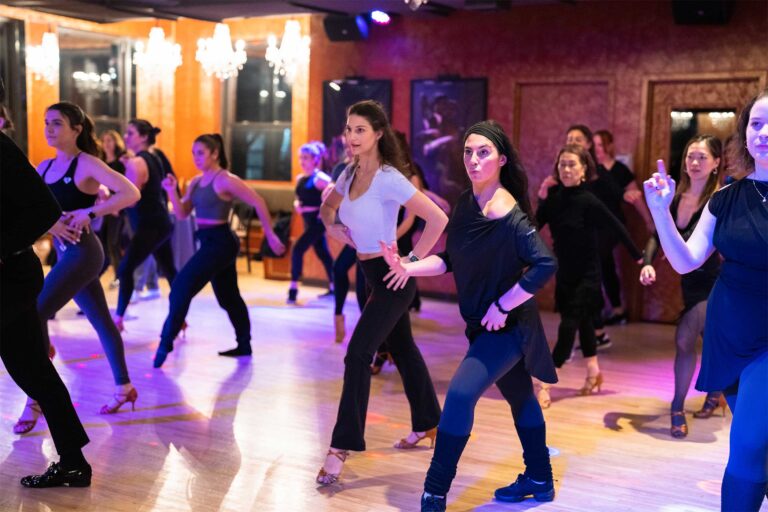
The best dance lessons for corporate wellness programs are private team sessions (a closed lesson booked only for your employees), recurring weekly series of 4 to 8 sessions, and individual private lessons that employees pay for with a wellness or lifestyle stipend. The styles that suit mixed-experience teams best are the ones with a simple basic step a first-timer can dance in one session: line dancing and merengue for groups that want no partner contact, and East Coast swing, salsa, or a slow waltz for teams comfortable dancing in pairs. A single team-building class is fun, but the wellness value of dance comes from repeating it, so the format matters as much as the style.
This guide is for HR leaders, people-ops teams, and office managers comparing dance against other wellness perks. It covers which lesson formats fit which goals, which dance styles work at work, how often to schedule sessions, how wellness benefits can pay for lessons, and how to measure whether the program worked.
Key Takeaways
- A private team dance lesson is a session booked exclusively for one company’s employees, either at a dance studio or at the company’s own office or event space.
- Corporate dance programs built as a recurring series of 4 to 8 weekly sessions deliver more wellness value than a one-time team-building class, because the stress and mood benefits of dance are linked to regular practice.
- Line dancing and merengue are the easiest dance styles for corporate groups that want no partner contact, while East Coast swing, salsa, and waltz work well for teams comfortable dancing in pairs.
- A 60-minute moderate-intensity dance session covers about 40% of the 150 minutes of weekly aerobic activity recommended for adults by the U.S. Physical Activity Guidelines.
- A $1,200 lifestyle spending account, the median annual funding level reported by benefits platform Compt, covers roughly 7 to 9 private lessons at Dance With Me’s posted rate of $123 to $155 per lesson.
- Dance lessons for general health are not an eligible medical expense under IRS Publication 502, so they are usually paid through a taxable lifestyle spending account or a company program budget, not through an HSA or FSA.
Building a wellness program for your team? Plan a corporate wellness dance program with Dance With Me at one of our studios or at your office.
What Does “Private Dance Lessons” Mean for a Corporate Wellness Program?
In a corporate setting, a private dance lesson usually means a session closed to the public and taught only for your team, not one-on-one coaching. Companies typically use three private formats: a private team session for a group, a private lesson series that repeats weekly, and individual private lessons employees book on their own with wellness funds.
Each format solves a different problem. A private team session is the fastest way to get a whole department moving together. A series turns that energy into a habit. Individual lessons give employees who want more than the group pace a way to keep going on their own schedule.
| Format | Best for | Typical setup |
|---|---|---|
| Private team session | Team building, offsites, kickoff events | One 60 to 90 minute lesson for a single group |
| Private lesson series | Ongoing wellness and stress relief | 4 to 8 weekly sessions, same group, same time |
| Individual private lessons | Employees who want personal progress | One-on-one or couple lessons, paid by stipend |
Many companies combine formats: a kickoff team session to recruit interest, a weekly series for the people who sign up, and stipend-eligible individual lessons for the employees who get hooked.
Teams from Unilever and Barclays have danced with us

Which Dance Styles Work Best for Employee Groups?
The best dance styles for employee groups have a basic step simple enough to learn in one session and music most people recognize. Line dancing, merengue, East Coast swing, salsa, and waltz all meet that bar, and they differ mainly in partner contact, energy level, and how much coordination they ask for.
| Style | Why it works at work | Watch out for |
|---|---|---|
| Line dancing | No partner, no touch, everyone moves in unison | Can feel repetitive after many weeks |
| Merengue | Simplest partner basic; can be danced solo | Lower challenge for experienced dancers |
| East Coast swing | Upbeat, social, quick early wins | Turns need clear rules on partner comfort |
| Salsa | High energy, strong cultural appeal | Faster timing frustrates some beginners |
| Waltz or foxtrot | Calm, posture-focused, lower intensity | Less cardio than Latin or swing |
| Dance fitness | Highest cardio, no partner needed | Feels like a workout, less like a skill |
For a first session with a mixed group, line dancing or merengue is the safest start because nobody has to hold a partner or follow a lead. Teams that respond well can move into a partner style in later weeks. Our guide to types of dances covers each style in more depth.
Should Employees Dance With Partners or Solo?
Most corporate dance programs work best when partner dancing is offered but never required. Employees vary in how comfortable they are with physical contact at work, so a good program gives every partner pattern a solo version and lets people choose.
Going solo does not mean giving up the team-building benefit. In a 2015 Oxford study published in Biology Letters, Bronwyn Tarr and colleagues found that dancing in synchrony with a group raised participants’ sense of closeness to one another, and that the effect held even for low-exertion movement. In practical terms, a room of coworkers doing the same line dance on the same count gets a bonding effect without anyone holding hands.
A few rules make partner work comfortable in a workplace:
- Rotation is optional. Employees can stay with one partner, rotate, or dance solo.
- No forced pairings across reporting lines. Managers and direct reports pair up only by choice.
- Hand holds only. Corporate sessions stay in open position, not close embrace, unless the group asks otherwise.
- The instructor models consent. Asking “may I?” before a hold sets the tone for the room.
Is a One-Time Team-Building Class Enough for Corporate Wellness?
A one-time dance class is a good team-building event, but it is not a wellness program on its own. The research linking dance to lower stress and higher well-being looks at people who dance regularly, not people who danced once.
The evidence points in that direction from several angles. A 2025 multidisciplinary review in Psychology of Sport and Exercise, led by researchers at the University of Surrey, concluded that dance combines music, rhythm, social contact, and movement in ways that support stress regulation and resilience. A 2022 three-country study in the Journal of International Marketing by Michela Vecchi and colleagues found that recreational dancers reported higher well-being and productivity than matched non-dancers, and the authors suggested including dance in corporate well-being programs.
The honest counterpoint matters too. A short 2019 workplace study of a dance aerobics intervention, summarized by the U.S. Department of Labor’s CLEAR research clearinghouse, found no drop in self-reported stress and no change in absenteeism 30 days after the program. One plausible reading is that a brief, workout-style program is not the same thing as learning a social dance people enjoy and come back to. That is why this guide recommends a series, a style employees choose, and a measurement plan, instead of a single high-intensity class.
For the broader case for dance at work, see 8 reasons dance improves office productivity, morale, and teamwork.
How Long and How Often Should Corporate Dance Sessions Run?
Most corporate dance programs run sessions of 45 to 60 minutes, once a week, for 4 to 8 weeks. That length fits a lunch break or the end of the workday, and a multi-week series gives employees enough repetition to dance a few patterns confidently by the final session.
The U.S. Physical Activity Guidelines recommend at least 150 minutes of moderate-intensity aerobic activity per week for adults, and the American Heart Association lists ballroom and social dancing as moderate-intensity activity. Using that benchmark, here is how much of the weekly target each common session length covers:
| Session length | Share of 150-minute weekly target | Fits best |
|---|---|---|
| 30 minutes | 20% | Midday movement break |
| 45 minutes | 30% | Lunch-hour series |
| 60 minutes | 40% | After-work series or team session |
These percentages assume moderate effort for the full session; actual intensity depends on the style and how much of the class is spent moving versus listening. An 8-week series of 60-minute sessions adds up to 480 minutes of dancing per participant.
Can Wellness Benefits Pay for Private Dance Lessons?
Yes, in many companies, but usually through a lifestyle spending account (LSA) or a company program budget, not through health accounts. IRS Publication 502 states that dance lessons taken only to improve general health are not a deductible medical expense, even when a doctor recommends them, which generally keeps them out of HSA and FSA eligibility.
Lifestyle spending accounts are the more common route. They are employer-funded reimbursement programs, and dance classes often fall under the physical wellness category, though each employer sets its own eligible list. Funds spent from an LSA are generally treated as taxable income for the employee.
The math is useful for HR teams setting a stipend amount. Benefits platform Compt reported a median all-inclusive LSA funding level of $1,200 per employee per year in 2025. At Dance With Me’s posted private lesson rate of $123 to $155, that stipend covers roughly 7 to 9 private lessons a year, or about one lesson every six weeks. Group classes at $30 stretch the same budget much further.
Wellness programs are already common, which makes dance easy to slot in. The 2025 KFF Employer Health Benefits Survey found that 56% of small firms and 83% of large firms offering health benefits run wellness promotion programs, such as smoking cessation, weight management, or lifestyle coaching.
This section is general information, not tax advice. Check plan rules and tax treatment with your benefits administrator or tax advisor.
How Do You Make a Dance Program Inclusive for Every Employee?
An inclusive corporate dance program is opt-in, never performance-based, and built so any employee can join regardless of fitness level, experience, mobility, or comfort with touch. The goal is participation, not polish.
- Make it voluntary. Attendance should never affect reviews, and nobody should be singled out to demonstrate.
- Offer solo versions of every pattern. This covers employees with cultural, religious, or personal limits on partner contact.
- Adapt for mobility. Dance With Me offers wheelchair dance lessons, and the same approach can be built into a team session.
- Keep the intensity adjustable. Instructors can show a low-impact and a full-energy version of each step.
- Skip the recital pressure. A showcase at the end of a series can be fun, but it should be optional.
- Set a simple dress code. Office clothes and comfortable shoes are enough; no special gear is needed.
How Do You Measure Whether a Corporate Dance Program Worked?
Measure participation first and well-being second. Attendance, repeat attendance, and a short before-and-after survey give HR a clear picture without overclaiming productivity gains the data can’t support.
| Metric | How to track it | What good looks like |
|---|---|---|
| Sign-up rate | Registrations divided by invited employees | Enough interest to fill a second series |
| Repeat attendance | Share of people attending 3 or more sessions | Most first-session attendees return |
| Self-reported stress | Same short survey before week 1 and after the final week | Scores move in the right direction |
| Connection | One question: “I feel connected to my coworkers” | Agreement rises over the series |
| Demand | Requests for another series or stipend use | Employees ask for more |
Context helps when presenting results. Gallup’s 2026 State of the Global Workplace report found that about half of employees in the U.S. and Canada reported feeling stress for much of the previous day, among the highest rates of any region.
How Do You Set Up Dance Lessons for Corporate Wellness Programs?
Setting up a program takes six decisions: the goal, the format, the style, the schedule, the location, and how you will measure it. Dance With Me can host sessions at any of its studios or bring instructors to your office or event venue.
- Pick the goal. Team bonding, ongoing stress relief, or an individual benefit for employees.
- Choose the format. A single team session, a weekly series, individual stipend lessons, or a mix.
- Choose a style. Start with line dancing or merengue for mixed groups, or swing, salsa, or waltz for teams open to partner work.
- Set the schedule. Lunch-hour or after-work sessions of 45 to 60 minutes work for most offices.
- Pick the location. A Dance With Me studio, your own office, or a booked event space.
- Plan the measurement. Send a short survey before the first session and after the last.
Our employee wellness and team building page has more on what corporate programs include.
Frequently Asked Questions
What is the best dance style for corporate team building?
Line dancing is the best starting style for most corporate team-building sessions because it needs no partner, has a short learning curve, and puts the whole group in sync on the same count. Teams that want more interaction can move on to merengue, East Coast swing, or salsa in later sessions.
Do employees need a partner or dance experience for a corporate dance lesson?
No. Corporate dance lessons are designed for complete beginners, and employees can come without a partner. Instructors pair people up only for partner styles, and every pattern can also be danced solo.
Can a dance instructor come to our office?
Yes. Dance With Me can bring instructors to your office or another venue for a private team session, or host your group at one of its studios. A conference room with the furniture moved aside is often enough space for a small group.
How much do corporate dance lessons cost?
Corporate dance pricing depends on group size, session count, and location, so most studios quote programs individually. For reference, Dance With Me’s posted rates are $123 to $155 for a private lesson, $30 for a group class, and $49 for an introductory private lesson.
Can employees use HSA or FSA funds for dance lessons?
Usually not. IRS Publication 502 says dance lessons taken only for general health are not a medical expense, even with a doctor’s recommendation. Employees are more likely to cover lessons through an employer lifestyle spending account, which is generally taxable.
How often should a corporate wellness dance program meet?
Once a week for 4 to 8 weeks is a practical structure for most companies. Weekly sessions give employees enough repetition to build confidence, and the stress and mood benefits linked to dance come from regular practice rather than a single class.
Plan a Corporate Wellness Dance Program
The right private dance lessons for your team depend on what you want the program to do: bring a department together for an afternoon, give employees a weekly stress break, or offer a benefit people use on their own. Dance With Me studios run private team sessions, weekly series, and individual private lessons for complete beginners, at our studios or at your workplace.
Plan a corporate wellness dance program with Dance With Me →