To dance the basic Cha-Cha, take two break steps on counts 2 and 3, followed by three compact chassé steps on 4-and-1. That creates five weight changes over four beats. Practice the rhythm first as “two, three, cha-cha-one,” keep each step small, and transfer your weight fully before adding hip action.
Cha-Cha—also called Cha-Cha-Cha—is playful, rhythmic, and easier to begin than its fast footwork might suggest. You can learn the pattern by yourself before dancing it with a partner, and you do not need to manufacture the characteristic hip movement. Once the timing, foot placement, and weight changes are working together, the movement begins to appear naturally.
This guide teaches an American Rhythm Cha-Cha basic for both leader and follower. You will learn how to hear the count, complete both halves of the basic, correct the most common mistakes, and combine your first steps into a simple beginner routine.
Key Takeaways
- The Cha-Cha basic step is danced on the count 2, 3, 4-and-1. It is a break step on 2, a replace on 3, and a three-step chassé on 4-and-1, which makes five weight changes across four beats of music.
- In the American Rhythm Cha-Cha basic, the leader breaks back with the right foot on count 2 while the follower breaks forward with the left. The second half reverses direction, so one full basic takes two measures of music.
- Cha-Cha breaks on count 2, not count 1. Some teachers add a preparatory side step on 1, but the repeating break-and-chassé pattern always begins on 2.
- The most common beginner timing error is counting “one, two, cha-cha-cha.” Saying “two, three, cha-cha-one” keeps the chassé on the correct beats.
- Cha-Cha is a Cuban partner dance from the early 1950s, danced in 4/4 time at roughly 120–128 BPM. It is danced to the cha-cha-chá music created by Cuban violinist and composer Enrique Jorrín.
- Cha-Cha hip action comes from complete weight transfer and knee action, not from deliberately swinging the hips. Beginners should lock in timing and foot placement before adding styling.
- Cha-Cha is taught in both American Rhythm and International Latin ballroom. Both styles share the 2, 3, 4-and-1 rhythm but differ in technique, figure names (crossover break vs. New Yorker), and competitive presentation.
- Cha-Cha can be learned without a partner. It is also a different dance from the Cha-Cha Slide, which is a modern line dance called out by the song’s lyrics.
The Cha-Cha Basic Step at a Glance
Cha-Cha is a Cuban dance performed in 4/4 time. The basic rhythm places single steps on counts 2 and 3, followed by a three-step chassé across counts 4-and-1. Although you may hear instructors say “cha-cha-cha,” counting 4-and-1 makes the relationship between the feet and music clearer.
-
Dance family: American Rhythm / International Latin
-
Origin: Cuba, early 1950s
-
Musical meter: 4/4 time
-
Basic count: 2, 3, 4-and-1
-
Basic structure: Break, replace, chassé
-
Weight changes: Five across four beats
-
Travel: Mostly stationary, with compact steps
-
Partner required?: No—you can practice the footwork alone
The pattern spans two musical measures. In the first half, the leader breaks backward and travels to the right during the chassé. In the second, the leader breaks forward and travels to the left. The follower dances the natural opposite.
If the terms American Rhythm and International Latin are new to you, do not let them interrupt your first practice. Both share the recognizable 2, 3, 4-and-1 rhythm. The important thing is to follow one consistent method instead of combining instructions from different versions.
First, Learn How to Count Cha-Cha
Cha-Cha music has four beats in each measure:
1, 2, 3, 4
The dance divides beat 4 into two quicker actions and continues onto beat 1 of the next measure:
2, 3, 4-and-1
2, 3, 4-and-1
The counts 2 and 3 each receive one step. The chassé has three steps: one on 4, one on “and,” and one on 1. You can say it as:
Two, three, cha-cha-one.
The final step on 1 is not an extra count. It is the first beat of the next measure. That is why casually counting “one, two, cha-cha-cha” can make a beginner place the break and chassé on the wrong beats.
Try this rhythm drill before moving your feet
- Count a steady 1, 2, 3, 4 and clap on each number.
- Continue counting, but change the second measure to 2, 3, 4-and-1.
- Clap once on 2, once on 3, then three times more quickly on 4-and-1.
- Repeat without speeding up the underlying music.
- Say two, three, cha-cha-one while keeping the same clapping rhythm.
If the “and” makes you rush count 1, slow down. Cha-Cha contains quick steps, but the basic rhythm should still feel controlled.
How to Dance the Cha-Cha Basic Step
Clear a small area and stand with your feet comfortably underneath you. Keep your knees relaxed, your posture lifted, and your steps compact. You can begin alone or face a partner.
Some American Rhythm teachers use a preparatory side step on count 1 to establish the starting position. If you use it, the leader steps left on 1 while the follower steps right. The repeating break-and-chassé pattern still begins on count 2.
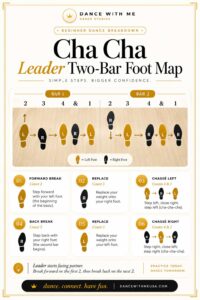
Leader’s Cha-Cha footwork
Begin with your weight primarily over your left foot so the right foot is available to move.
| Count | Foot and action | Direction | Weight cue |
|---|---|---|---|
| 2 | Step with the right foot | Back | Transfer weight onto the right foot |
| 3 | Replace weight onto the left foot | In place | Recover fully onto the left |
| 4 | Step with the right foot | Side right | Begin the chassé |
| & | Bring the left foot toward the right | Closing action | Change weight briefly onto the left |
| 1 | Step with the right foot | Side right | Finish with weight over the right |
| 2 | Step with the left foot | Forward | Transfer weight onto the left foot |
| 3 | Replace weight onto the right foot | In place | Recover fully onto the right |
| 4 | Step with the left foot | Side left | Begin the returning chassé |
| & | Bring the right foot toward the left | Closing action | Change weight briefly onto the right |
| 1 | Step with the left foot | Side left | Finish with weight over the left |
You have now completed one full basic. Your right foot is free again, ready to repeat the backward break on count 2.
Follower’s Cha-Cha footwork
Begin with your weight primarily over your right foot so the left foot is available to move.
| Count | Foot and action | Direction | Weight cue |
|---|---|---|---|
| 2 | Step with the left foot | Forward | Transfer weight onto the left foot |
| 3 | Replace weight onto the right foot | In place | Recover fully onto the right |
| 4 | Step with the left foot | Side left | Begin the chassé |
| & | Bring the right foot toward the left | Closing action | Change weight briefly onto the right |
| 1 | Step with the left foot | Side left | Finish with weight over the left |
| 2 | Step with the right foot | Back | Transfer weight onto the right foot |
| 3 | Replace weight onto the left foot | In place | Recover fully onto the left |
| 4 | Step with the right foot | Side right | Begin the returning chassé |
| & | Bring the left foot toward the right | Closing action | Change weight briefly onto the left |
| 1 | Step with the right foot | Side right | Finish with weight over the right |
The follower’s pattern mirrors the leader’s. When the leader moves back, the follower moves forward; when the leader chassés right, the follower chassés left.
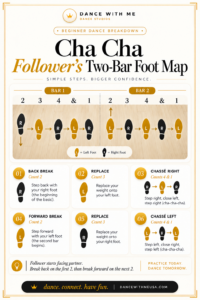
Put both halves together
At first, speak every count aloud:
Back, replace, side-close-side.
Forward, replace, side-close-side.
Then attach the musical timing:
2, 3, 4-and-1.
2, 3, 4-and-1.
Practice without music until you can finish each half on the correct foot. Then use slow music and repeat the basic for four complete cycles. If you lose your place, stop and restart on a clear count 1 rather than trying to chase the beat.
How to Add Natural Cha-Cha Hip Action
Cha-Cha hip action begins with the floor, not with deliberately swinging your hips from side to side. Each time you transfer your weight, the receiving leg supports the body while the other leg becomes free. The alternation through the feet, knees, and legs allows the pelvis to respond.
Focus on this order:
- Place the foot.
- Transfer your weight.
- Allow the supporting leg to straighten naturally without locking the knee.
- Let the free knee relax.
- Keep your upper body lifted and relatively quiet.
Do not add large hip movements before the weight changes are clear. If your hips move but your balance remains between both feet, the action will look forced and make the next step harder.
Small steps help. When a chassé travels too far, you have less time to complete the three weight changes and are more likely to bounce, reach, or fall behind the music.
Technique cue: Move your center over the standing foot before trying to style the free side of your body. Correct weight transfer creates the conditions for natural Latin motion.
Want an instructor to check your timing and weight transfer? Learn about Cha-Cha lessons at Dance With Me. Beginners are welcome, and no partner is required.
A Simple Cha-Cha Routine for Beginners
Once the basic feels consistent, use it as the home base for your first routine. Keep the movements compact and return to the basic whenever you need to recover the timing.
1. Dance two complete basics
Repeat the backward break, right chassé, forward break, and left chassé twice. This gives you time to establish the rhythm before adding a new direction.
2. Add a crossover break
Open slightly away from your partner and turn enough to step across your body on count 2. Replace your weight on 3, then use the chassé on 4-and-1 to return and change sides. The movement is often called a crossover break in American Rhythm and is
3. Return to one complete basic
Use the basic to reset your direction, connection, and timing. This is a useful habit in social dancing: the basic is not filler; it is where partners reorganize the dance.
4. Add an underarm turn
The leader creates space and raises the connected hand without pulling the follower through the turn. The follower continues to step on the Cha-Cha rhythm while rotating beneath the joined hands. Keep the turn small and finish facing your partner.
5. Finish with another basic
Return to the familiar pattern and continue dancing. A clean basic after a turn is more valuable than adding several figures before either partner has recovered balance.
Your first routine is therefore:
- Two Cha-Cha basics
- Crossover breaks to both sides
- One Cha-Cha basic
- One underarm turn
- One Cha-Cha basic to finish
The written description introduces the sequence, but turns and partner leads are much easier to understand visually. Use the embedded demonstration and learn each figure separately before combining them.
Six Common Cha-Cha Mistakes and How to Fix Them
| What happens | Likely cause | How to correct it |
|---|---|---|
| You consistently finish behind the music | Your steps are too large, especially during the chassé | Reduce the distance and keep all three steps underneath your body |
| The “cha-cha-cha” feels disconnected from the song | You are placing the triple action on three full beats | Count it as 4-and-1: two quick weight changes followed by the step on 1 |
| Your free foot will not move easily | Your weight remains divided between both feet | Finish each transfer over one supporting foot before moving the other |
| Your hips feel forced | You are moving the pelvis independently of the legs | Prioritize foot placement, weight transfer, and knee action |
| You bounce upward on every step | You are pushing vertically instead of moving across the floor | Keep your head level, soften the knees, and send energy sideways through compact steps |
| You lose your partner during a turn | The lead is coming from the arm or the turn is too large | Maintain a comfortable frame, create space, and keep the turning steps on rhythm |
Another common habit is watching your feet continuously. Looking down changes your posture and does not necessarily improve accuracy. Learn the pattern slowly, check your feet when needed, and then practice looking forward while feeling which foot holds your weight.
How to Practice Cha-Cha at Home
You do not need a partner to build rhythm, foot placement, and balance. A partner becomes more important when you start working on connection, leads, follows, and turns.
Use this short practice sequence:
Minute 1: Clap the rhythm
Clap 2, 3, 4-and-1 for several measures. Keep the numbered beats even and fit the “and” between 4 and 1.
Minute 2: Mark the feet
Dance the pattern with very small steps and minimal styling. Speak “back, replace, side-close-side; forward, replace, side-close-side.”
Minute 3: Check the weight changes
Pause after each step. The unused foot should feel free enough to lift lightly from the floor. If it does not, complete the transfer before continuing.
Minute 4: Add slow music
Repeat one complete basic at a time. Stop if you lose the phrase, identify the next count 1, and begin again.
Minute 5: Add posture and expression
Look forward, keep the steps compact, and let your arms respond naturally. Add personality only after the timing is stable.
Film one short practice from the front and another from behind. Compare the video with the DWM demonstration: Are your steps landing on the same counts? Do you finish over one foot? Does the chassé stay compact?
American Rhythm vs. International Latin Cha-Cha
Cha-Cha appears in both American Rhythm and International Latin ballroom programs. The versions share Cuban roots, 4/4 music, the characteristic 2, 3, 4-and-1 rhythm, compact steps, and coordinated Latin body action. They differ in codified technique, syllabus terminology, permitted figures, and competitive presentation.
| Element | American Rhythm Cha-Cha | International Latin Cha-Cha |
|---|---|---|
| Context | Social and competitive American-style ballroom | International DanceSport and social instruction |
| Shared foundation | Break actions and chassés on 2, 3, 4-and-1 | Break actions and chassés on 2, 3, 4-and-1 |
| Common terminology | Crossover break, underarm turn, open-break actions | New Yorker, spot turn, hand-to-hand, syllabus figures |
| Beginner priority | Clear rhythm, weight transfer, connection, and social usability | Clear rhythm, weight transfer, technique, and syllabus structure |
This guide demonstrates an American Rhythm starting pattern. If you are preparing for a competition or examination, follow your instructor’s technique and syllabus rather than combining conventions from unrelated tutorials.
To see where Cha-Cha fits alongside Rumba, Swing, Samba, Jive, and other styles, explore the different types of ballroom dance.
What Cha-Cha Step Should You Learn Next?
After you can repeat the basic without losing 2, 3, 4-and-1, build your vocabulary gradually:
- Crossover break or New Yorker: changes the body direction while preserving the core rhythm.
- Underarm turn: introduces rotation and partner coordination.
- Hand-to-hand: develops opening actions and controlled changes of direction.
- Spot turn: teaches you to rotate over a compact area without traveling away from the rhythm.
- Forward and backward lock steps: add progressive movement once the basic chassé is stable.
Master one new figure on its own, connect it to a basic, and then try it with music. That process is more reliable than memorizing a long sequence of steps you cannot yet dance on time.
If you enjoy quick, energetic Latin footwork, you may also like our guide to how to dance Jive. For a broader comparison, see our guide to ballroom dance styles and their characteristics.
Learn Cha-Cha with a Dance With Me Instructor
A video can show you where to place your feet. A skilled instructor can see why the movement does not yet feel the way it looks—and adjust your timing, balance, step size, posture, and partner connection in real time.
Dance With Me welcomes complete beginners. You can learn Cha-Cha through private instruction and studio practice opportunities, whether you come alone or with a partner. Lessons are adapted to your goals, experience, and pace instead of forcing every student through the same routine.
Ready to turn the steps into dancing? Explore Cha-Cha lessons at Dance With Me or find a Dance With Me studio near you.
Find Cha Cha Classes Near You
No matter your age, fitness history, or current coordination, there is a beginner class tailored to your pace. Find the best Cha Cha Dance Classes near you. and discover how rewarding, fun, and transformative learning to dance can be today!
Dance Studios in New York:
Dance Studios in New Jersey:
Dance Studios in Texas:
- Dance Studio in Austin
- Dance Studio in Southlake
- Dance Studio in Houston
- Dance Studio in The Woodlands
- Dance Studio in Fort Worth
Dance Studios in Georgia:
Dance Studios in Las Vegas:
Dance Studios in Connecticut:
Don’t see your city? Find a Dance With Me studio near you →
Frequently Asked Questions About Dancing Cha-Cha
What is the basic step of Cha-Cha?
The basic Cha-Cha combines two break actions with two chassés. The leader breaks back with the right foot on 2, replaces onto the left on 3, and chassés right on 4-and-1. The leader then breaks forward with the left foot and chassés left. The follower mirrors those actions.
How do you count the Cha-Cha?
Ballroom Cha-Cha is commonly counted 2, 3, 4-and-1. Counts 2 and 3 each receive one step. The three-step chassé falls on 4, the half-beat “and,” and count 1 of the next measure. Saying “two, three, cha-cha-one” can help you remember the rhythm.
Does Cha-Cha start on count 1 or count 2?
The characteristic break action begins on count 2. Some teachers use a preparatory side step on count 1 before the first break, particularly when introducing an American Rhythm basic. The preparation does not change the repeating 2, 3, 4-and-1 timing.
Which foot does the Cha-Cha leader start with?
In the American Rhythm pattern taught here, the leader begins the first break by stepping back with the right foot on count 2. The follower mirrors that action by stepping forward with the left foot. Other figures and teaching setups can begin differently, so follow the convention used in your lesson.
Can you learn Cha-Cha without a partner?
Yes. You can practice the count, basic footwork, chassé, weight transfer, balance, and many individual turns alone. A partner or instructor becomes valuable when you work on connection, leading, following, partnered turns, and social-dance navigation.
Is Cha-Cha difficult for beginners?
The basic pattern is approachable, but the split beat and complete weight changes require practice. Most beginners improve faster when they first clap the rhythm, then mark small steps without styling, and only add music and hip action after the sequence is stable.
What kind of music can you dance Cha-Cha to?
Cha-Cha can be danced to traditional Cuban cha-cha-chá as well as suitable Latin pop and Latin rock with a clear 4/4 pulse. Beginners should choose slower tracks with an easy-to-hear beat before practicing to faster or more rhythmically complex music.
What is the difference between Cha-Cha and Salsa?
Both are Latin partner dances commonly performed in 4/4 time, and some figures can look related. Cha-Cha’s defining feature is its three-step chassé on 4-and-1. Salsa usually uses three weight changes across a four-beat phrase with a pause or held count rather than the Cha-Cha chassé.
Is Cha-Cha the same as the Cha-Cha Slide?
No. Cha-Cha is a Cuban partner dance with a break-and-chassé rhythm. The Cha-Cha Slide is a modern line dance guided by spoken instructions in the song. They share part of a name but use different structures, music, and movement vocabularies.
Start with the Rhythm. Then Make It Your Own
You do not need elaborate turns to dance a convincing Cha-Cha. Begin with the part that defines it: two controlled break steps followed by a compact chassé on 4-and-1. Transfer your weight, keep the steps underneath you, and let the rhythm organize the rest of the movement.
Once the basic feels dependable, add one crossover break, one turn, and a little more personality. If you want personalized feedback, learn Cha-Cha at Dance With Me—no partner or previous dance experience is required.