To dance jive, you dance a six-beat basic counted 1, 2, 3a4, 5a6: rock back on your left foot on 1, replace your weight forward onto your right on 2, then dance a three-step chassé to your left on 3a4 and a three-step chassé to your right on 5a6.
Keep your weight over the balls of your feet, your knees close together and your steps small, and let each kick come from the knee rather than the whole leg.
Jive is danced to 4/4 music at roughly 128–165 BPM socially and up to 176 in competition. — rock ‘n’ roll, big band swing and boogie-woogie — and it stays in one spot rather than travelling around the floor.
That’s the whole dance in one paragraph. The rest of this guide breaks it down properly: the exact footwork for leader and follower, how to hear the “a” count in the chassé, the technique that separates a jive that looks sharp from one that looks frantic, five figures to learn after the basic, and a four-week practice plan you can actually follow at home.
Key Takeaways
- The jive basic step is six beats counted 1, 2, 3a4, 5a6. It is a rock step followed by two three-step chassés, one to each side.
- In the jive basic, the leader rocks back on the left foot, replaces onto the right, then chassés left and chassés right. The follower mirrors it by rocking back on the right foot, chasséing right, then chasséing left. Both partners travel in the same direction in space.
- The jive chassé is deliberately uneven. The first step takes ¾ of a beat, the “a” takes ¼, and the last step takes a full beat. Syllabus books write it as QQ QaQ QaQ. Dancing an even “3-and-4” is the most common beginner error, and it makes jive look like swing.
- Jive is danced in 4/4 time at roughly 128–165 BPM socially and 176 BPM (44 bars per minute) in competition. Beginners should practice near 130 BPM.
- Jive is one of the five International Latin dances, alongside Samba, Cha-Cha, Rumba and Paso Doble. Its roots are American swing, not Latin America: it grew out of the jitterbug and Lindy Hop danced in African American communities in the 1930s and was later codified in the UK.
- Jive is a stationary dance. Weight stays over the balls of the feet, knees stay close together, and steps cover only a few inches. The jive basic contains no kicks: kicks come from the knee and flicks from the ankle, and both appear only in later figures.
- Jive and East Coast Swing both use a rock step and two triple steps over six beats, but they differ in style. Jive is an International Latin competition dance with straight supporting legs and sharp leg action. East Coast Swing is a bouncier, bent-knee American Rhythm social dance at about 136–144 BPM. Modern Jive, or Ceroc, is a 1980s UK social dance with an unsyncopated four-count basic.
- Most beginners can dance the jive basic to slow music after one lesson. The first figures to learn next are the Link, the Fallaway Rock, both Changes of Places and the American Spin. A comfortable social jive usually takes three to six months, and no partner is needed to start.
Jive at a Glance
-
Style family: International Latin (one of five, alongside Samba, Cha-Cha, Rumba, and Paso Doble)
-
Origin: African American communities in the United States, early 1930s
-
Music: Rock ‘n’ roll, big band swing, boogie-woogie, and jump blues
-
Timing: 4/4 time — six-beat basic counted 1, 2, 3a4, 5a6
-
Tempo: 128–160 BPM socially; 176 BPM (44 bars per minute) in competition
-
Basic step: Rock step followed by two chassés
-
Travel: Stationary — danced in a small area rather than progressing around the floor
-
Difficulty: Easy to start, challenging to master — the footwork is simple, but the speed demands precision
-
Best for: Dancers looking for the highest-energy dance in ballroom
Before You Take a Single Step: Jive Posture
Almost every beginner problem in jive is a posture problem wearing a footwork costume. Set these four things first and the steps get dramatically easier.
- Weight forward, over the balls of your feet. Heels stay light — they brush the floor but never carry your weight. If you sit back on your heels, you can’t move fast enough for the chassé.
- Knees close together, toes slightly turned out. Jive looks wide and wild from the audience, but the feet stay underneath the body. Wide steps are the single most common reason beginners fall behind the music.
- Small steps. A jive chassé covers a few inches, not a few feet. Compact footwork is what lets you dance at 176 BPM without sprinting.
- A light forward body pitch. Chest slightly ahead of hips, ribs lifted, shoulders quiet. The bounce lives in your knees and ankles, never in your shoulders.
Hold a light, toned frame with your partner — enough resistance for a lead to travel, never so much that you’re pulling. Most jive figures are led from the body through an elastic arm connection, not by yanking with the hands.
How to Dance the Basic Jive Step
The jive basic is six beats long: two beats for the rock step, then two chassés of two beats each. Read it slowly once, then walk it through with no music at all.
Leader’s footwork
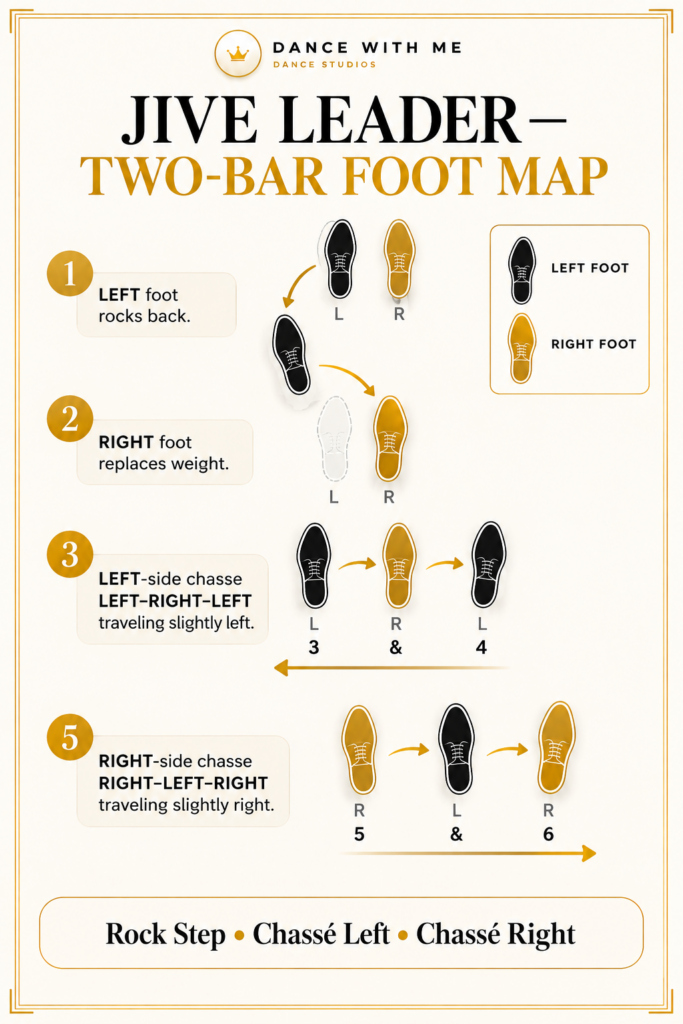
- Count 1 — Rock back. Step back onto the ball of your left foot. Small step, knee soft, weight fully transferred.
- Count 2 — Replace. Push off and replace your weight forward onto your right foot, back where it started.
- Count 3 — Chassé to the left. Step to your left side with your left foot.
- Count “a” — Close. Close your right foot to your left foot. This is the fastest beat in the dance — a quarter of a beat.
- Count 4 — Step side. Step to your left again with your left foot.
- Count 5 — Chassé to the right. Step to your right side with your right foot.
- Count “a” — Close. Close your left foot to your right foot.
- Count 6 — Step side. Step to your right again with your right foot.
- Start again on count 1.
Follower’s footwork
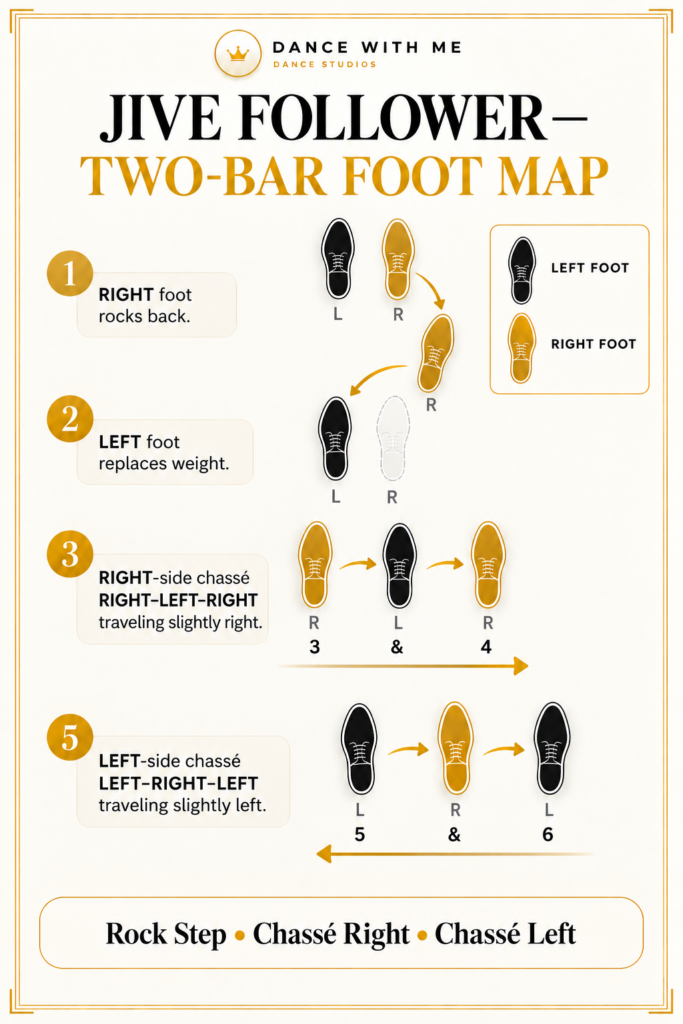
The follower mirrors the leader — this is the detail most online guides get wrong by printing the leader’s part twice.
- Count 1 — Rock back. Step back onto the ball of your right foot.
- Count 2 — Replace. Replace your weight forward onto your left foot.
- Counts 3a4 — Chassé to your right. Right, close left, right.
- Counts 5a6 — Chassé to your left. Left, close right, left.
- Start again on count 1.
Both partners travel in the same direction in space on each chassé, which is why the leader goes left while the follower goes right.
The variation you’ll also see: Basic in Place
Some studios teach the Basic in Place first, where both chassés are danced on the spot instead of travelling side to side. It’s the same rhythm with less movement, and it’s a useful stepping stone if the side-to-side version is throwing off your balance.
How to Count Jive: The Timing Explained
Jive’s rhythm is what makes it sound like jive. It is not an even triple step — the middle beat of each chassé is much shorter than the other two, and that unevenness is the entire flavor of the dance.
-
Count 1: Rock back — 1 beat
-
Count 2: Replace — 1 beat
-
Count 3: Side — ¾ beat
-
Count a: Close — ¼ beat
-
Count 4: Side — 1 beat
-
Count 5: Side — ¾ beat
-
Count a: Close — ¼ beat
-
Count 6: Side — 1 beat
Say it out loud: “rock, step, one-a-two, one-a-two.” The “a” should feel like it’s stolen from the beat before it, not shared evenly with the beats around it.
The most common beginner error is dancing an even 3-and-4 — half a beat, half a beat, one beat. It’s not wrong enough to look broken, but it’s what makes a jive read as swing rather than jive. Fix it early and everything above it improves.
You’ll also see jive counted QQ QaQ QaQ in syllabus books (quick-quick, quick-and-quick, quick-and-quick), and some figures are written across eight beats instead of six. Same dance, different notation.
Jive Technique: Six Things That Separate Sharp From Frantic
- Straighten the supporting knee on each step. International Latin technique uses a straight supporting leg. That straightening is what produces jive’s hip action — you never push the hips deliberately.
- Kick from the knee, flick from the ankle. A jive kick swings the lower leg from a stable knee. A flick is smaller and comes from the ankle. Whole-leg kicks are slow, unstable and the reason beginners run out of time.
- Keep the feet under the body. Thighs stay close, inside edges of the feet lead. If your feet are outside your shoulders, your step is too big.
- Bounce down, not up. The energy comes from compressing into the floor through the knees and ankles and letting it rebound, not from hopping upward.
- Stay in your square. Jive is a stationary dance. If you’re drifting across the floor, you’re travelling on the chassé instead of stepping side and closing.
- Dance the accents on 2, 4 and 6. That’s where the kicks, contractions and shapes land. Beginners tend to accent 1; jive breathes on the even counts.
Five Jive Moves to Learn After the Basic
Once you can dance the basic to music for a full song without counting out loud, these five figures — all from the beginner syllabus — will get you through a social dance floor.
1. The Link. The connecting figure of jive. From an open position with hands joined, the follower is led back to a closed or side-by-side position across a chassé. Almost every other figure ends by linking back to the basic, so learn this second, not last.
2. Fallaway Rock. The basic danced in fallaway position — both partners turned slightly away from each other in a V shape, rocking back on the outside foot. It’s the same rhythm you already know in a new shape, which makes it the cheapest new move you’ll ever learn.
3. Change of Places, Right to Left. The leader raises the joined hands and turns the follower to her right, and the two swap positions across the two chassés. This is jive’s underarm turn, and it’s the figure most people picture when they picture jive.
4. Change of Places, Left to Right. The mirror image — the follower is turned back the other way, returning to where she started. Learn it immediately after the right-to-left version so you can loop the two together endlessly.
5. American Spin. The leader sends the follower away, then spins her on the spot with a light push from the palm rather than a pull. A crowd-pleaser that teaches you an essential jive principle: momentum is offered, not forced.
What comes next: the Whip, Stop and Go, Change of Hands Behind Back, Chicken Walks and the Mooch. That group is where jive starts to feel like jive rather than like homework.
How to Practice Jive at Home: A Four-Week Plan
You don’t need a partner or a studio floor to build the timing. You need about fifteen minutes a day and a hard, non-carpeted surface.
Week 1 — Rhythm only, no partner. Stand still and clap or tap the count: 1, 2, 3a4, 5a6. Then add the chassés alone, sideways, at 128–136 BPM. Goal: the “a” sounds compressed, not even.
Week 2 — The full basic, slow. Add the rock step. Dance the whole six-count basic to music at 136–150 BPM until you can do it for a full song without counting aloud. Film yourself once and check one thing only: are your feet staying under your body?
Week 3 — Add the Link and one Change of Places. Practice the transitions in and out of the basic, not the figures in isolation. The joins are what break down on a social floor, never the figures.
Week 4 — Tempo ladder. Dance the same material at 150, then 160, then 176 BPM. When it falls apart, drop back one rung and stay there. Speed is the last thing you add, not the first.
Two drills worth more than any figure:
- The wall drill. Stand with your back a few inches from a wall and dance the basic. If you bump the wall, you’re rocking too far back — the rock step is small.
- The book drill. Dance the chassés with a book held lightly between your knees. If it drops, your feet are travelling too wide.
Jive Music and Tempo: What to Practice To
Jive is danced to 4/4 music with a strong backbeat. In competition it’s played at 44 bars per minute — 176 BPM — but almost nobody should start there.
-
Learning the chassé: 120–136 BPM — Slow enough to place every foot deliberately
-
First full basics: 136–150 BPM — Comfortable social jive; most party bands live here
-
Social floor standard: 150–165 BPM — Classic rock ‘n’ roll and jump blues
-
Competition tempo: 176 BPM (44 bpm bars) — Everything must already be automatic
Genres that work: 1950s rock ‘n’ roll, jump blues, boogie-woogie piano, big band swing, rockabilly, and a surprising amount of modern pop and soul with a hard backbeat. Anything you could clap along to at a wedding is probably jiveable.
Building a practice playlist: sort your tracks by BPM rather than by artist, and practice up the ladder in order. A free BPM analyzer will tell you what you’ve got. Ten songs, arranged slowest to fastest, is a better practice tool than a hundred songs in random order.
Five Common Jive Mistakes (and the Fix)
Even triple steps
- Why it happens: Counting “3-and-4” instead of “3a4”
- The fix: Say “one-a-two” out loud; make the “a” late and short
Feet too far apart
- Why it happens: Trying to make the dance look big
- The fix: Book drill; keep thighs close, steps a few inches
Falling behind the music
- Why it happens: Steps too large, weight on heels
- The fix: Halve your step size before you slow the music down
Bouncing from the shoulders
-
Why it happens: Effort in the upper body
-
The fix: Let the knees and ankles do all the compression
Travelling around the floor
-
Why it happens: Chassés drifting instead of closing
-
The fix: Mark a square on the floor and stay inside it
Jive vs. East Coast Swing vs. Modern Jive
Three dances share DNA and get confused constantly. Here’s what actually separates them.
Jive
-
System: International Latin
-
Origin: US, 1930s; codified in the UK
-
Count: 6 beats: 1, 2, 3a4, 5a6
-
Tempo: 128–176 BPM
-
Legs: Straight supporting leg, sharp kicks and flicks
-
Feel: Compact, explosive, competitive
East Coast Swing
-
System: American Rhythm
-
Origin: US dance studios, 1940s
-
Count: 6 beats: rock step + two triples
-
Tempo: 136–144 BPM
-
Legs: Bent-knee, bouncy, rounder
-
Feel: Circular, relaxed, social
Modern Jive (Ceroc)
-
System: Social club dance, no syllabus body
-
Origin: UK, 1980s (from French jive)
-
Count: 4 beats, no syncopation
-
Tempo: Wide range, any pop with a beat
-
Legs: Simple walking steps
-
Feel: Easiest of the three to start
The short version: all three descend from the same swing family. Jive is the version that went to competition and got faster and sharper. East Coast Swing is the version that stayed social and stayed bouncy. Modern Jive is the version that stripped out the syncopation so anyone could dance it on the first night.
If you want the full family tree, see our guide to the types of swing dance, or read where jive sits among the different styles of ballroom dance.
How Long Does It Take to Learn Jive?
- One lesson: the basic step, danced to a slow song.
- Four to six weeks: the basic plus the Link and both Changes of Places, at social tempo.
- Three to six months: a comfortable social jive — you can hear the music, lead or follow cleanly, and get through a fast song without panicking.
- Years: competition-level technique. The footwork stops being the hard part very early; the timing, the leg action and the speed never stop being refinable.
Jive is not the easiest dance to start, East Coast Swing and Cha-Cha both take less to look good — but it’s one of the most satisfying to keep, because the same six counts carry you from your first lesson to your last.
Find the Best Dance Classes Near You
Jive is a dance you can read about and a dance you have to feel. The chassé timing, the leg action and the elastic connection between partners are all things an instructor can fix in thirty seconds and a video can’t fix at all.
Choose a studio below and find the best dance classes near you at Dance With Me — no partner and no experience required.
Dance Studios in New York:
Dance Studios in New Jersey:
Dance Studios in Texas:
- Dance Studio in Austin
- Dance Studio in Southlake
- Dance Studio in Houston
- Dance Studio in The Woodlands
- Dance Studio in Fort Worth
Dance Studio in Georgia:
Dance Studio in Nevada:
Dance Studio in Connecticut:
Don’t see your city? Find a Dance With Me studio near you →
Frequently Asked Questions
What is the basic jive step? The basic jive step is a six-beat pattern counted 1, 2, 3a4, 5a6: a rock step back and forward, followed by a three-step chassé to the left and a three-step chassé to the right. The leader rocks back on the left foot and the follower mirrors on the right.
How do you count jive? Jive is counted 1, 2, 3a4, 5a6 in 4/4 time. Counts 1 and 2 are full beats; in each chassé the first step takes three quarters of a beat, the “a” takes a quarter, and the last step takes a full beat. In syllabus notation it’s written QQ QaQ QaQ.
Is jive hard to learn? The footwork is simple but the speed is not. Most beginners can dance the basic step to slow music within one lesson and reach a comfortable social jive in three to six months. The hard parts are the uneven “a” timing and keeping steps small enough to stay with fast music.
What is the difference between jive and East Coast Swing? Both use a rock step and two triple steps over six beats, but jive is an International Latin competition dance with straight supporting legs, sharp kicks and flicks, and tempos up to 176 BPM. East Coast Swing is an American Rhythm social dance — bouncier, more circular, bent-kneed, and usually slower.
Is jive a Latin dance or a swing dance? Both, depending on who’s asking. Jive is competed as one of the five International Latin dances, but its roots are in American swing rather than Latin America — it grew out of the same jitterbug and Lindy Hop lineage as East Coast Swing and boogie-woogie.
What tempo is jive danced at? Competition jive is played at 44 bars per minute, which is 176 beats per minute in 4/4 time. Socially, jive is usually danced between 128 and 165 BPM, and beginners should start nearer 130 BPM.
What music can you jive to? Rock ‘n’ roll, jump blues, boogie-woogie, big band swing and rockabilly are the classic choices, and plenty of modern pop and soul with a strong backbeat works too. Anything in 4/4 at roughly 130–176 BPM that makes you want to tap your foot on the offbeat will do.
What is the difference between ballroom jive and modern jive? Ballroom jive is the codified International Latin dance with a syncopated 3a4 chassé and a fixed syllabus of figures. Modern jive, often called Ceroc or French jive, was developed in 1980s Britain and removed the syncopation entirely, using a simpler four-count basic so beginners can dance on their first night.
Do you kick in every jive step? No. The basic step has no kicks at all — it’s a rock step and two chassés. Kicks and flicks appear in figures like the Whip, Chicken Walks and Fallaway Throwaway, and in choreography. Beginners should get the timing solid before adding any leg action.
What shoes should you wear to jive? Something with a smooth sole that lets you swivel and pivot without sticking, and enough support to spend a class on the balls of your feet. Trainers with grippy rubber soles are the one thing to avoid — they catch on the floor and can twist a knee at jive speeds.
Ready to try it on a real floor? Book your first lesson at a Dance With Me studio — no partner or experience required, and find the best dance classes near you in New York, New Jersey, Texas, Georgia, Connecticut or Las Vegas.