To dance tango, you walk to a slow-slow-quick-quick-slow rhythm in a closed hold with your partner. The leader steps forward left (slow), forward right (slow), forward left (quick), side right (quick), then draws the left foot closed (slow) — while the follower mirrors it backward. That five-step sequence, called the tango basic, fills eight beats of music and is the foundation of every tango step that comes after it.
Tango has a reputation for being dramatic and difficult. The drama is real. The difficulty is mostly a myth: the basic step is a walk, and most beginners can dance it to music inside a single lesson. This guide walks you through the frame, the walk, the basic, and your first three variations — plus how tango styles differ, how long it really takes to learn, and what you can practice on your own before you ever touch a partner.
Key Takeaways
- The tango basic is five steps danced over eight beats to a slow-slow-quick-quick-slow rhythm. Each slow takes two beats and each quick takes one.
- In the ballroom tango basic, the leader steps forward left, forward right, forward left, side right, then draws the left foot closed. The follower mirrors it backward: back right, back left, back right, side left, close.
- The tango close takes no weight, so the next tango basic starts on the same foot. Stepping onto the closing foot is the most common reason beginners start the next basic on the wrong foot.
- Ballroom tango has no rise and fall. Tango is danced level, grounded and staccato, in 4/4 time (sometimes written 2/4) at roughly 120–132 beats per minute, travelling counter-clockwise around the floor.
- Tango is led through the torso, not the arms. The tango frame is a compact closed hold offset slightly to each dancer’s left, with both heads turned left. Beginners should learn the tango walk, called the caminata, before any pattern.
- Most beginners can dance the tango basic to music after one lesson. Social confidence usually takes 6–10 weeks of weekly classes, and comfortable social dancing takes about 4–6 months.
- “Tango” covers three main dances: American tango (pattern-based, the hold can open), International tango (closed hold at all times, danced in Standard competition), and Argentine tango (improvised, danced in close or open embrace at milongas). A group class at a ballroom studio almost always teaches American tango.
- Tango originated in the Río de la Plata region of Argentina and Uruguay, in Buenos Aires and Montevideo, in the late 1800s. UNESCO recognized tango as joint Argentine-Uruguayan cultural heritage in 2009. Tango is not Brazilian; the “Brazilian tango” of the early 1900s was the maxixe.
- Tango does not require a partner to learn. Group classes rotate partners, and solo technique, called técnica sola, is a standard part of tango training.
How Does Tango Work? Rhythm, Timing and Hold
-
Rhythm: Slow, Slow, Quick, Quick, Slow (S-S-Q-Q-S)
-
Timing: Slow = 2 beats, Quick = 1 beat; the basic uses 8 beats total
-
Music: 4/4 time, roughly 120–132 beats per minute for ballroom tango
-
Hold: Closed position, slightly more compact and offset than waltz or foxtrot
-
Movement: Staccato and grounded — no rise and fall, no bounce
-
Direction: Ballroom tango travels counter-clockwise around the floor
-
First step to learn: The tango walk (caminata) — before any pattern
-
Time to first full dance: One 45–60 minute lesson for the basic; 6–10 weeks for social confidence
Before You Step: The Tango Frame and Posture
Tango is led and followed through the body, not the arms. If your frame collapses, the lead disappears — so this comes before footwork.
Stand and connect like this:
- Stand tall, weight forward. Keep your spine long and your weight over the balls of your feet, not your heels. You should feel ready to move at any instant.
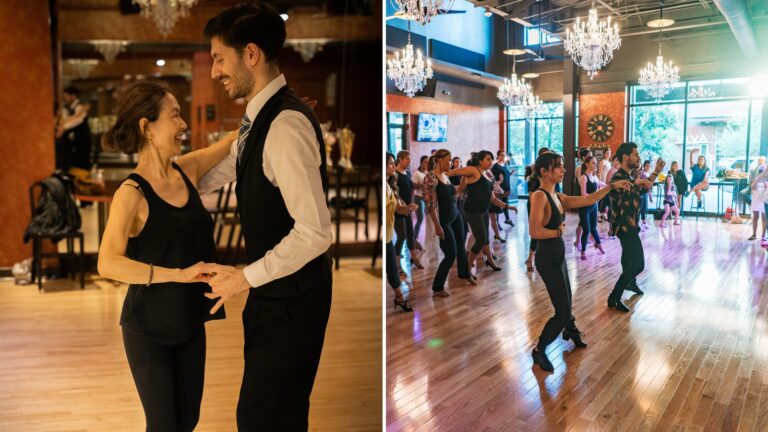
- Come into closed position, slightly offset. Partners stand chest to chest but shifted a few inches to their own left, so each person looks past the other’s right shoulder rather than head-on. This offset is what makes tango’s walking steps possible without stepping on toes.
- Leader’s right hand goes lower and further around. Place it under the follower’s left shoulder blade, wrapped a little further around the back than in waltz or foxtrot. The follower’s left hand rests behind the leader’s upper arm, fingers tucked under, not draped on top.
- Joined hands stay at eye-to-chin height. Leader’s left hand and follower’s right hand connect at roughly the follower’s eye level, elbows down and forward.
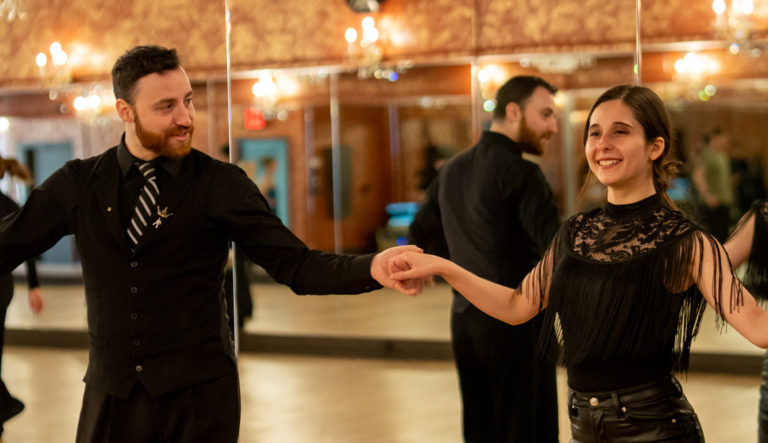
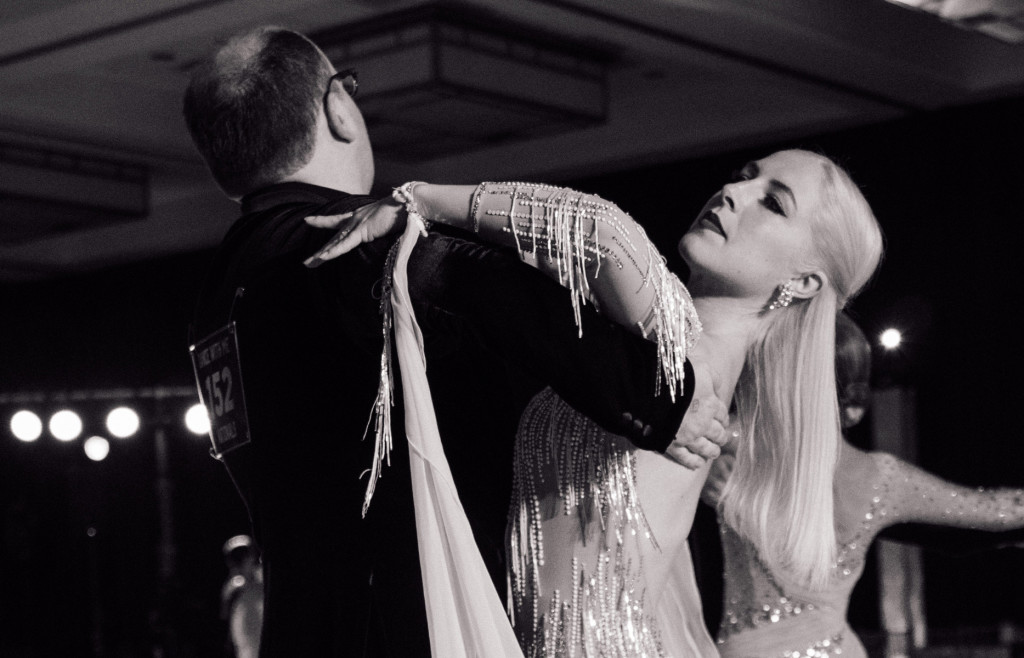
- Heads turn left. Both dancers look out over their own left side. The follower’s head stays turned left with a slight tilt back — this is the classic tango line, and it’s why tango photographs the way it does.
- Knees soft, feet flat. Tango is danced with a low, grounded, cat-like walk. There is no rise and fall — the head stays level all the way through the pattern.
Beginner tip: if you can’t feel your partner’s chest move before your feet move, the frame is too loose. Tango is a conversation between torsos.
Step 1: Learn the Tango Walk (Caminata) First
Every tango figure is built on the walk, and it’s the one thing that separates dancers who look like they’re doing tango from dancers who look like they’re doing a pattern.
The leader’s forward walk: step forward with the heel first, then roll through to the flat foot, drawing the moving leg past the standing leg. Let your body arrive over the foot before you take the next step. Keep the knees close together as you pass — this “collecting” is what gives tango its controlled, deliberate look.
The follower’s back walk: reach back with the toe first, then lower the heel as your weight arrives. Keep your chest up and forward toward your partner even as your feet travel backward. Do not sit back or lean away — the connection lives in the upper body.
Practice walking eight slow steps down a hallway before you ever try the basic. Tango is a walking dance dressed in drama.
Step 2: How to Dance the Tango Basic, Step by Step
This is the standard eight-beat American/ballroom tango basic. A memory trick many instructors use: spell T-A-N-G-O, one letter per step.
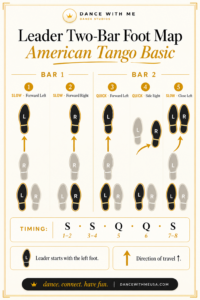
Leader Steps
-
Counts 1–2 | Slow (T): Step forward with left foot
-
Counts 3–4 | Slow (A): Step forward with right foot
-
Count 5 | Quick (N): Step forward with left foot (smaller)
-
Count 6 | Quick (G): Step side and slightly forward with right foot
-
Counts 7–8 | Slow (O): Draw left foot closed to right, no weight change
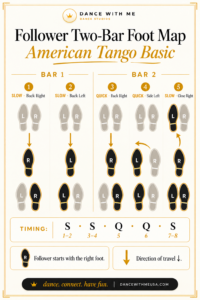
Follower Steps
-
Counts 1–2 | Slow (T): Step back with right foot
-
Counts 3–4 | Slow (A): Step back with left foot
-
Count 5 | Quick (N): Step back with right foot
-
Count 6 | Quick (G): Step side with left foot
-
Counts 7–8 | Slow (O): Draw right foot closed to left, no weight change
How to practice it:
- Count out loud: “slow… slow… quick-quick… slow.” Say it before you dance it.
- Steps 1–3 are walks. Only steps 4 and 5 change the shape.
- The final draw (the tango close) is a slide, not a step. Keep the foot in contact with the floor and finish with feet together, ankles touching.
- Finish sharp. Tango’s signature is the crisp, staccato stop at the end of each basic — arrive, then hold.
Once the basic is comfortable, dance it continuously to music. Because the closing step takes no weight, you can start the next basic immediately with the same foot.
Step 3: Your First Four Tango Variations
Once the basic is automatic, these three figures give you enough vocabulary to dance a whole song without repeating yourself.
The Promenade (Corte / Fifth Position Break)
The most recognizable tango picture. From the closed hold, the leader rotates the frame so both dancers open into a V-shape facing the same direction, then both walk two or three steps down the line of dance before closing back. It’s usually danced Slow-Quick-Quick-Slow and gives you a natural change of direction on a crowded floor.
The Left Turn (Rock Turn)
Instead of walking straight, the leader rocks in place and rotates the couple counter-clockwise a quarter turn at a time. This is your steering wheel — it’s how you navigate corners and avoid other couples without stopping the dance.
Ochos (Figure Eights)
More common in Argentine tango than ballroom tango, but worth learning early. The leader stops their own movement and pivots the follower so their feet trace a figure eight on the floor — forward ochos travel toward the leader, back ochos travel away. Ochos teach pivoting and axis control, which pays off in every other tango figure.
Bonus: Tango Ganchos (Intermediate):
Ballroom Tango vs. Argentine Tango: Which One Are You Learning?
This is the single most common source of beginner confusion, because “tango” describes several related dances.
American (Ballroom) Tango
-
Where You’ll See It: Social ballrooms, studio classes, weddings
-
Hold: Closed, with the option to open and separate
-
Feel: Dramatic, staccato, pattern-based
-
Best For: Beginners, wedding dances, showcase routines
International Tango
-
Where You’ll See It: Ballroom competition (Standard division)
-
Hold: Closed at all times, never released
-
Feel: Sharp, powerful, highly technical
-
Best For: Competitors and medal-track students
Argentine Tango
-
Where You’ll See It: Milongas (social tango events), tango festivals
-
Hold: Close embrace or open embrace
-
Feel: Improvised, intimate, walking-based
-
Best For: Dancers who want improvisation over choreography
Milonga
-
Where You’ll See It: Argentine tango social dances
-
Hold: Same as Argentine tango (close or open embrace)
-
Feel: Faster, playful, bouncier
-
Best For: Dancers who already have the tango walk
Tango Vals
-
Where You’ll See It: Argentine tango social dances
-
Hold: Same as Argentine tango (close or open embrace)
-
Feel: Flowing, waltz-timed, continuous
-
Best For: Dancers who want a softer, circular tango
If you’re taking a group class at a ballroom studio, you’re almost certainly learning American tango. That’s the version this guide teaches, and it’s the fastest route to dancing socially. Argentine tango is a separate discipline with its own vocabulary; many dancers eventually learn both. Compare them side by side on our tango and Argentine tango pages.
Is Tango a Difficult Dance to Learn?
Tango is moderately difficult, harder than rumba or East Coast swing, easier than the Viennese waltz or quickstep. The basic step is genuinely easy because it’s built on walking, and most beginners dance it to music within one lesson. What takes longer is the quality: the staccato timing, the level head, and the body-led connection that makes tango look like tango rather than a march.
Here’s a realistic timeline for a beginner taking one lesson a week and practicing lightly between:
-
1 Lesson — The Basic: Dance the S-S-Q-Q-S basic to slow music.
-
2–3 Weeks — Basic + One Variation: Repeat the basic with a promenade, on time.
-
6–10 Weeks — Social Floorcraft: Dance a full song with a stranger, navigating the floor.
-
4–6 Months — Comfortable Social Dancer: Lead or follow 4–6 figures with musicality.
-
1–2+ Years — Advanced Technique: Ochos, pivots, close embrace, improvisation, styling.
What makes tango feel hard — and how to fix it:
- The staccato rhythm. Tango stops and starts. Fix: exaggerate the pause at the end of each basic until it feels theatrical.
- No rise and fall. Dancers who come from waltz instinctively bounce. Fix: practice walking with a book on your head.
- The offset hold. It feels awkward for the first ten minutes and normal forever after. Fix: trust it and stop looking down.
- Leading and following with the body. Fix: practice the walk with hands on each other’s shoulder blades and no arm frame at all.
Can You Dance Tango by Yourself?
Yes! solo practice is a standard part of learning tango, and it’s how serious dancers build technique. Tango is a partner dance, so you can’t dance a full social tango alone, but nearly every element that makes tango look good is trained solo. Argentine tango schools formally teach técnica sola (solo technique) for exactly this reason.
What to practice without a partner:
- The walk. Ten minutes of slow forward and backward walking with correct heel-toe and toe-heel rolls does more for your tango than any pattern.
- Weight changes. Shift side to side on the beat until you can land precisely on the music.
- Collecting. Bring your feet fully together on every step, ankles brushing. This one habit fixes most beginner sloppiness.
- Pivots and ochos. Trace figure eights on the floor, pivoting on the standing leg with your axis stacked over it.
- Musicality. Play tango recordings and clap the slow-slow-quick-quick-slow pattern until you can hear it instantly.
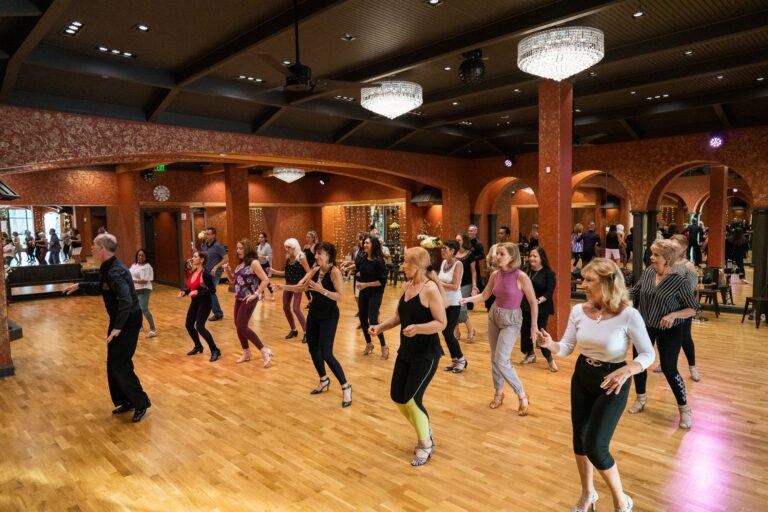
You can also attend group classes solo. At most studios — including Dance With Me — group classes rotate partners, so you do not need to bring a partner to learn tango.
Is the Tango a Brazilian Dance?
No. Tango is not Brazilian. It originated in the Río de la Plata region shared by Argentina and Uruguay, in the working-class neighborhoods of Buenos Aires and Montevideo in the late 1800s. In 2009, UNESCO inscribed tango on its Representative List of the Intangible Cultural Heritage of Humanity as a joint Argentine-Uruguayan tradition.
The confusion has a real historical source. The maxixe, a Brazilian partner dance from late-1800s Rio de Janeiro, was widely marketed in Europe and the United States as the “Brazilian tango” during the early-1900s dance craze. It’s a genuinely Brazilian dance — but it isn’t tango. Brazil’s own national partner dances are the samba and forró.
Tango’s roots are a blend: European immigrant music, African rhythmic traditions from the Río de la Plata’s Black communities, and local Argentine and Uruguayan folk forms like the milonga and candombe. From Buenos Aires it traveled to Paris around 1912, then to New York and London — and the smoothed, standardized version that came back is what ballroom studios teach as American and International tango today.
Tango Music: How to Hear the Beat
Tango is written in 4/4 or 2/4 time with a strong, marching pulse. Ballroom tango is danced at roughly 120–132 beats per minute — steady, insistent, and easy to find once you know what to listen for.
Classic tracks to practice with:
- La Cumparsita — Gerardo Matos Rodríguez (the most famous tango ever written, and Uruguayan)
- Por una Cabeza — Carlos Gardel (the Scent of a Woman tango)
- El Choclo — Ángel Villoldo
- Adiós Nonino — Ástor Piazzolla (advanced; nuevo tango, harder to dance to as a beginner)
Count the strong beats out loud: 1-2-3-4. Your slow steps take two beats each; your quick steps take one. If you can march to it, you can tango to it.
Five Mistakes Beginners Make (and How to Avoid Them)
- Looking at your feet. Your feet already know where they are. Keep your head up and turned left — looking down collapses the frame and kills the lead.
- Bouncing. Tango has no rise and fall. Imagine your head sliding along a low ceiling.
- Rushing the quicks. Quick-quick is fast, but it isn’t panicked. Land each one on its beat.
- Stepping onto the closing foot. The tango close takes no weight. If you shift onto it, you’ll start the next basic on the wrong foot.
- Leading with the arms. Arms transmit, torsos initiate. Move your chest first and the step follows.
Your First 30 Days: A Practice Plan
- Week 1: Frame and walk only. Ten minutes a day of solo walking, forward and backward.
- Week 2: The eight-beat basic, counted out loud, then to slow music.
- Week 3: Add the promenade and the rock turn. Practice linking two figures without stopping.
- Week 4: Dance a full three-minute song. Then take a group class and dance it with someone new.
Thirty days of this puts you ahead of most people who have “been meaning to learn tango” for years.
Find the Best Tango Dance Classes Near You
Reading about tango is a start — but tango is led and followed through connection, and connection is the one thing you can’t learn from a screen. A single lesson with a professional instructor will fix posture and timing habits that would take months to unlearn on your own.
Choose a studio below and find the best dance classes near you at Dance With Me. No partner and no experience required — our group classes rotate partners, and beginners are the majority of every class.
Dance Studios in New York:
Dance Studios in New Jersey:
Dance Studios in Texas:
- Dance Studio in Austin
- Dance Studio in Southlake
- Dance Studio in Houston
- Dance Studio in The Woodlands
- Dance Studio in Fort Worth
Dance Studio in Georgia:
Dance Studio in Las Vegas:
Dance Studio in Connecticut:
Don’t see your city? Find a Dance With Me studio near you →
Frequently Asked Questions
What are the basic steps of tango dancing? The basic tango step is a five-step, eight-beat sequence danced to a slow-slow-quick-quick-slow rhythm. The leader steps forward left, forward right, forward left (quick), side right (quick), then draws the left foot closed without changing weight. The follower mirrors it backward: back right, back left, back right, side left, close. Every other tango figure builds on this pattern and the tango walk underneath it.
Is tango a difficult dance to learn? Tango is moderately difficult. The basic step is easy because it’s built on walking, and most beginners dance it to music within one lesson. Reaching a comfortable social level usually takes 6–10 weeks of weekly classes. What takes longer is tango’s staccato timing, level head, and body-led connection — the qualities that separate correct footwork from real tango.
Can you dance tango by yourself? Yes, for practice. Solo tango technique — the walk, weight changes, collecting, pivots, and ochos — is a standard part of training and is formally taught in Argentine tango schools as técnica sola. You can’t dance a full social tango alone, since it’s a partner dance, but you also don’t need a partner to take classes: most studios rotate partners in group lessons.
Is the tango a Brazilian dance? No. Tango originated in the Río de la Plata region of Argentina and Uruguay — specifically the working-class neighborhoods of Buenos Aires and Montevideo in the late 1800s — and UNESCO recognized it as a joint Argentine-Uruguayan cultural heritage in 2009. The confusion comes from the maxixe, a Brazilian dance from Rio de Janeiro that was marketed abroad as the “Brazilian tango” in the early 1900s.
What is the difference between ballroom tango and Argentine tango? Ballroom tango (American and International) is pattern-based, danced in a fixed closed hold with sharp, staccato movement and a strong emphasis on line and presentation. Argentine tango is improvised, danced in a close or open embrace, and built almost entirely on the walk and pivots rather than memorized figures. Ballroom tango is faster to learn socially; Argentine tango offers more improvisational depth.
How many counts is the tango basic? Eight beats. The rhythm is slow (2 beats), slow (2 beats), quick (1 beat), quick (1 beat), slow (2 beats) — five steps across eight counts of music.
Do you need a partner to learn tango? No. Group classes at most studios rotate partners throughout the lesson, so you’ll dance with several people regardless of whether you arrive alone. Solo technique work is also a normal part of tango training.
What should I wear to a tango class? Comfortable clothes you can move in, and shoes with a smooth sole that let you pivot — leather-soled dress shoes or dance shoes are ideal. Avoid rubber-soled sneakers, which grip the floor and can strain your knees during turns.
What music is tango danced to? Traditional tango in 4/4 or 2/4 time at roughly 120–132 beats per minute. Classic tracks include La Cumparsita, Por una Cabeza, and El Choclo. Ballroom studios also teach tango to modern songs with the same driving, marching pulse.
How long does it take to learn tango? Most beginners dance the basic step in a single lesson and can hold their own at a social dance within 6–10 weeks of weekly classes. Reaching a comfortable, versatile social level takes about 4–6 months; advanced technique and improvisation take a year or more.
Is tango the same as salsa? No. Tango is a close-hold, walking-based partner dance in 4/4 time from Argentina and Uruguay, with grounded, staccato movement. Salsa is a Cuban-rooted Latin dance in 4/4 with a quick-quick-slow rhythm, hip motion, and open-hold turn patterns. They share almost no technique.