How to do the Electric Slide: repeat one 18-count pattern and turn a quarter to the left each time: travel right for 4 counts, travel left for 4 counts, walk back for 4 counts, rock forward and back for 4 counts, then step forward on your left foot with a quarter turn left and scuff your right foot (2 counts). The count sheet is: 1-2-3-4 right · 5-6-7-8 left · 9-10-11-12 back · 13-14-15-16 rock · 17-18 turn. It is a four-wall line dance, so after four repetitions you are facing the front again.
That is the whole dance. Everything below is the detail that makes it actually work on a crowded wedding floor: which foot starts, the two different ways people travel side to side, exactly where the turn happens, how long each pattern takes at the speed of the real song, and why your aunt might be doing four extra counts that nobody else is.
Key Takeaways
- The Electric Slide is a four-wall line dance built on an 18-count pattern that repeats for the whole song, with a quarter turn to the left at the end of every pattern.
- The Electric Slide always starts by stepping to the right with the right foot, and the only turn in the dance happens on counts 17 and 18.
- The version danced at most weddings and parties has 18 counts, while choreographer Ric Silver’s original 1976 dance, “The Electric,” has 22 counts.
- At the tempo of “Electric Boogie” by Marcia Griffiths (roughly 107–108 beats per minute), one 18-count pattern takes about 10 seconds and a full rotation through all four walls takes about 40 seconds.
- Dancers travel side to side in the Electric Slide in one of two ways, a grapevine (step, cross behind, step, touch) or a side-together-side-touch, and both use the same counts and finish on the same foot.
- The Electric Slide is one of the easiest line dances for beginners because it has only five short sections, no partner and a single turn direction.
Want to dance it with confidence at your next wedding or party? Book a $49 intro lesson at a Dance With Me studio — no partner and no experience needed.
What Is the Electric Slide?
The Electric Slide is a partnerless line dance in which everyone repeats the same 18-count step pattern, turning 90 degrees to the left after each repetition so the group faces a new wall. It is traditionally danced to “Electric Boogie,” the reggae-pop song written by Bunny Wailer and recorded by Marcia Griffiths, and it has been a fixture at American weddings, family reunions, cookouts and school dances for more than three decades.
In line dance terms, the Electric Slide is a beginner-level, 4-wall dance. “Four-wall” means the pattern is danced once facing each of the four walls of the room before you return to where you started. If line dancing vocabulary is new to you, our guide to what line dancing is explains walls, counts and step sheets.
Electric Slide Quick Facts
| Fact | Detail |
|---|---|
| Type | Line dance, no partner |
| Walls | 4 (quarter turn left after each pattern) |
| Counts per pattern | 18 (social version); 22 (Ric Silver’s original) |
| Starting foot | Right foot, traveling right |
| Turn | One quarter turn left, counts 17–18 |
| Level | Beginner |
| Classic song | “Electric Boogie,” Marcia Griffiths |
| Song tempo | About 107–108 BPM |
| Time per 18-count pattern | About 10 seconds |
| Time for all four walls | About 40 seconds |
How Do You Do the Electric Slide Step by Step?
The Electric Slide has five sections: right, left, back, rock and turn. Learn each section slowly without music, then link them together, then add the song. Counts are one step per beat unless a step says “touch,” which means you tap the foot without putting weight on it.
Section 1: Travel Right (Counts 1–4)
- Count 1: Step your right foot to the right.
- Count 2: Bring your left foot next to your right foot (or cross it behind your right foot — see the grapevine option below).
- Count 3: Step your right foot to the right again.
- Count 4: Touch your left foot next to your right foot without putting weight on it. Many people clap here.
Section 2: Travel Left (Counts 5–8)
- Count 5: Step your left foot to the left.
- Count 6: Bring your right foot next to your left foot (or cross it behind).
- Count 7: Step your left foot to the left again.
- Count 8: Touch your right foot next to your left foot. Clap.
Section 3: Walk Back (Counts 9–12)
- Count 9: Step back on your right foot.
- Count 10: Step back on your left foot.
- Count 11: Step back on your right foot.
- Count 12: Touch your left foot next to your right foot. Clap.
Section 4: Rock Forward and Back (Counts 13–16)
- Count 13: Step forward on your left foot.
- Count 14: Touch your right foot next to or behind your left foot.
- Count 15: Step back on your right foot.
- Count 16: Touch your left foot in front of or next to your right foot.
Section 5: Quarter Turn Left (Counts 17–18)
- Count 17: Step forward on your left foot while turning a quarter turn (90 degrees) to the left.
- Count 18: Brush or scuff your right foot forward along the floor, keeping your weight on your left foot.
Your right foot is now free, so count 1 of the next pattern — stepping right — happens naturally. Repeat from the beginning, facing the new wall.
Electric Slide Count Sheet (Print This)
| Counts | Section | Feet | Direction |
|---|---|---|---|
| 1–4 | Travel right | R side, L together (or behind), R side, L touch | → Right |
| 5–8 | Travel left | L side, R together (or behind), L side, R touch | ← Left |
| 9–12 | Walk back | R back, L back, R back, L touch | ↓ Back |
| 13–16 | Rock | L forward, R touch, R back, L touch | ↕ In place |
| 17–18 | Turn | L forward with ¼ turn left, R scuff | ↺ Quarter turn left |
What Is the Difference Between the Grapevine and Side-Together Versions?
There are two common ways to travel side to side in the Electric Slide, and both are correct. In the grapevine version, count 2 crosses the left foot behind the right (and count 6 crosses the right behind the left). In the side-together version, count 2 simply closes the left foot next to the right. The counts, the starting foot and the finishing foot are identical, so dancers using either version stay in sync.
The grapevine is closer to Ric Silver’s original choreography and travels farther across the floor. The side-together version is smaller and easier on a packed dance floor or for dancers who aren’t comfortable crossing their feet. Most online tutorials pick one without saying the other exists, which is why two people who both “know” the Electric Slide sometimes look slightly different on counts 2 and 6. If you’re unsure which the room is doing, the side-together version is the safer choice because it takes less space.
| Grapevine version | Side-together version | |
|---|---|---|
| Count 2 (and 6) | Cross behind | Close next to |
| Distance traveled | Larger | Smaller |
| Best for | Open floors, more styling | Crowded floors, beginners, older dancers |
| Closest to the original | Yes | No |
| Stays in sync with the other version | Yes | Yes |
How Long Does One Electric Slide Pattern Take?
At the tempo of “Electric Boogie,” one 18-count Electric Slide pattern takes about 10 seconds, and dancing it once on all four walls takes about 40 seconds. That means a full 3-minute-48-second version of the song gives you time for roughly 22 repetitions — more than five complete rotations of the room.
| 18-count version (social) | 22-count version (original) | |
|---|---|---|
| One beat at ~107.5 BPM | 0.56 s | 0.56 s |
| One pattern | ~10.0–10.1 s | ~12.2–12.3 s |
| All four walls | ~40 s | ~49 s |
| Repetitions in a 3:48 track | ~22–23 | ~18–19 |
| Full rotations of the room | ~5.7 | ~4.6 |
Calculation by Dance With Me from published tempo measurements of “Electric Boogie” (107–108 BPM) and the 3:48 album track length; timing per count = 60 ÷ BPM. Remixes and DJ edits may run faster or longer.
Two practical takeaways come out of those numbers. First, at a little over half a second per step, the Electric Slide is relaxed enough for nearly any beginner — slower per step than an East Coast Swing basic. Second, because the song is long and the pattern is short, you will repeat it more than 20 times. If you lose your place, you can stop, watch the people around you for one 10-second pattern, and rejoin on the next count 1.
Why Do Some People Dance a 22-Count Electric Slide?
Choreographer Richard “Ric” Silver created the dance in 1976 as a 22-count routine called “The Electric,” but the version that spread through clubs, weddings and parties dropped four counts and became the 18-count Electric Slide most people know today. Silver has said he chose 22 counts because his birthday is January 22.
The four missing counts are an extra forward-and-back rock before the turn: in the 22-count version, you rock forward and back twice (counts 13–20) before stepping into the quarter turn on counts 21–22. The 18-count version rocks once. Because the extra counts are a repeat of the same rock, the shorter version is easier to remember — which is a big part of why it won.
The 18-count variation became widely popular around 1989, the same year a remix of “Electric Boogie” took the song to a national U.S. audience. In 2007, Silver issued takedown notices against YouTube videos of people dancing the 18-count version; the Electronic Frontier Foundation challenged him on behalf of a videographer, and the dispute settled with Silver agreeing to license the dance under a Creative Commons noncommercial license.
What this means for you: if you’re at a wedding and someone near you keeps rocking twice before turning, they’re not wrong — they’re dancing the original. Follow the majority of the room, which in almost every case will be the 18-count version.
What Songs Can You Do the Electric Slide To?
The Electric Slide is traditionally danced to “Electric Boogie” by Marcia Griffiths, but it works with almost any song with a steady, medium-tempo 4/4 beat. Because the pattern is short and repeats, it doesn’t need to match the song’s phrases perfectly.
Songs commonly used for the Electric Slide include:
- “Electric Boogie” — Marcia Griffiths (the original; written by Bunny Wailer)
- “Candy” — Cameo (a staple at family gatherings and cookouts)
- “Before I Let Go” — Frankie Beverly and Maze (widely used at reunions and weddings)
The best Electric Slide songs sit at a moderate, walkable tempo — “Electric Boogie” itself is around 107–108 BPM. Very fast songs make the back-walk and rock sections feel rushed; very slow songs make the scuff on count 18 feel long. If the DJ plays something faster than you’re used to, make your steps smaller rather than trying to cover the same distance.
When Do You Start the Electric Slide in the Song?
Start on count 1 of a musical phrase — usually once the beat is clearly established after the song’s intro — with your weight on your left foot so your right foot is free to step right. In practice, most people watch the front of the floor and start when the first group of confident dancers steps right.
If you’re the one starting the line, listen for a strong downbeat and count “5, 6, 7, 8” out loud before stepping right on “1.” Because the pattern is 18 counts long and most pop music is phrased in groups of 8 or 32, the Electric Slide will drift in and out of the song’s phrases as it repeats. That is normal — nobody resets to the music, and you shouldn’t either. Stay with the room.
What Are the Most Common Electric Slide Mistakes?
The most common Electric Slide mistakes are starting with the wrong foot, turning to the right instead of the left and turning on the wrong count. Each one puts you out of sync with the line within a single pattern.
| Mistake | What happens | Fix |
|---|---|---|
| Starting to the left | You collide with the person beside you on count 1 | Always step right first, with the right foot |
| Turning right | You face the opposite wall from everyone else | The Electric Slide only turns left (counterclockwise) |
| Turning too early, on the back walk | You walk backward into the next row | The only turn is on count 17 |
| Putting weight on the touch | Your next step starts on the wrong foot | Touches are taps — keep your weight on the standing foot |
| Big grapevines on a crowded floor | You kick or step on neighbors | Switch to the side-together version |
| Forgetting the rock | You turn four counts early | After the back walk, rock forward, rock back, then turn |
A simple memory phrase helps: “Right, left, back, rock, turn.” Say it under your breath for the first few patterns and the dance takes care of itself.
Is the Electric Slide Easy for Beginners?
Yes — the Electric Slide is one of the easiest line dances to learn, and most beginners can dance it to a full song after 10 to 15 minutes of practice. It has only five short sections, one turn that always goes the same direction, no partner work and a relaxed tempo of about half a second per step.
What makes it beginner-friendly is that each section is something you already do: walking sideways, walking backward and shifting your weight forward and back. The only new skill is the quarter-turn pivot on count 17, and because you always turn the same way, it becomes automatic after a handful of repetitions.
Easy modifications:
- For crowded floors or limited mobility: use side-together instead of grapevines and take small steps.
- For older dancers: skip the scuff on count 18 and simply touch the right foot next to the left.
- For kids: teach the clap on counts 4, 8 and 12 first — it gives them a beat to hit and keeps them in time.
How Is the Electric Slide Different From the Cha Cha Slide?
The Electric Slide is a memorized 18-count pattern that repeats without instructions, while the Cha Cha Slide is a call-out dance in which the song’s lyrics tell you what to do. In the Electric Slide, the music doesn’t change your steps; in the Cha Cha Slide, you follow the vocal cues (“slide to the left,” “criss-cross”) as they come.
| Electric Slide | Cha Cha Slide | |
|---|---|---|
| How you know the steps | Memorized pattern | Lyrics call each move |
| Pattern | Same 18 counts every time | Changes with the song |
| Turns | Quarter turn left every pattern | Only when the song calls it |
| Classic song | “Electric Boogie” | “Cha Cha Slide” (DJ Casper) |
| Better for | Any song with a steady beat | Its own song only |
Because the Electric Slide works with many songs, it’s the more versatile of the two. Because the Cha Cha Slide tells you what to do, it’s easier to join cold. Most wedding DJs play both.
Where Can You Learn the Electric Slide and Other Line Dances?
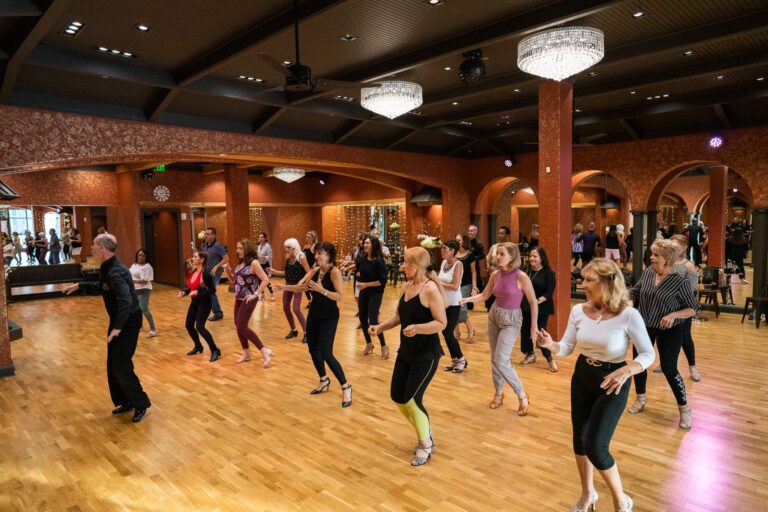
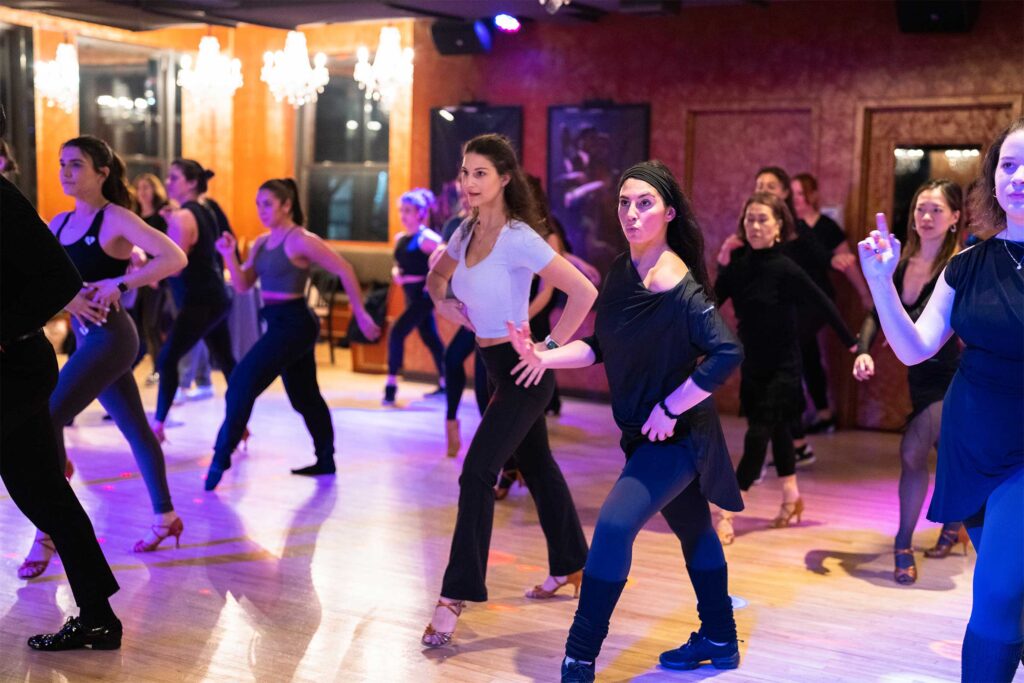
You can learn the basic Electric Slide at home from this guide and a video, but a group class is the fastest way to dance it smoothly with other people. In a studio, an instructor can fix the two things that are hardest to notice on yourself — weight on the touches and the timing of the turn — in the first few minutes, and you practice in an actual line with real spacing.
At Dance With Me, line dances like the Electric Slide are taught in our group dance classes, and private lessons are available if you’d rather practice before a wedding without an audience. Students in Texas can also join dedicated line dancing classes in Fort Worth.
Frequently Asked Questions
What are the steps to the Electric Slide?
The Electric Slide steps are: step right, together, right, touch (counts 1–4); step left, together, left, touch (5–8); walk back right, left, right, touch (9–12); rock forward on the left and back on the right with touches (13–16); then step forward on the left with a quarter turn left and scuff the right foot (17–18). Repeat facing the new wall.
How many counts is the Electric Slide?
The Electric Slide most people dance has 18 counts. Choreographer Ric Silver’s original 1976 version, called “The Electric,” has 22 counts because it repeats the forward-and-back rock one extra time before the turn. Both versions are four-wall dances with a quarter turn to the left.
Which way do you turn in the Electric Slide?
You turn a quarter turn (90 degrees) to the left in the Electric Slide, on counts 17 and 18 at the end of every pattern. The turn always goes left, or counterclockwise, so after four patterns you are facing the front of the room again.
Who created the Electric Slide?
Choreographer Richard “Ric” Silver created the Electric Slide in 1976, originally as a 22-count dance called “The Electric,” set to Bunny Wailer’s song “Electric Boogie.” The shorter 18-count version that spread through clubs and weddings became widely popular around 1989.
What song is the Electric Slide danced to?
The Electric Slide is traditionally danced to “Electric Boogie,” written by Bunny Wailer and recorded by Marcia Griffiths. It’s also commonly danced to “Candy” by Cameo and “Before I Let Go” by Frankie Beverly and Maze, and it works with most songs that have a steady medium-tempo beat.
Is the Electric Slide a four-wall dance?
Yes. The Electric Slide is a four-wall line dance: each 18-count pattern ends with a quarter turn to the left, so you dance it once facing each of the four walls before you’re back at the front. At the tempo of “Electric Boogie,” one full rotation takes about 40 seconds.
Dance the Electric Slide With Confidence at Your Next Event
The Electric Slide takes 10 minutes to learn from a page and a few real repetitions to feel natural in a line of people.
If you have a wedding, reunion or party coming up and want to walk onto the floor knowing exactly what you’re doing, or want to add a few more line dances to your list, an instructor can get you there in a single session.