To dance the waltz, count the music in 3/4 time — 1-2-3, 1-2-3 — and dance the box step. The leader steps forward with the left foot on 1, side with the right on 2, and closes the left on 3; then back with the right on 4, side with the left on 5, and closes the right on 6. The follower mirrors the pattern. Add a gentle rise and fall, hold a lifted closed-position frame, and you’re waltzing.
That’s the whole dance in one paragraph — but doing it so it looks like a waltz takes a few more details. This guide walks you through waltz timing, posture and frame, the basic box step for both leader and follower, rise and fall, your first turns, the songs to practice with, and the mistakes that make beginners look stiff (and how to fix each one in a single practice session).
Waltz at a Glance
Time signature: 3/4 — three beats per measure, strong accent on beat 1
Count:“1-2-3, 1-2-3” (or “1-2-3, 4-5-6” for a full box)
Tempo: Roughly 84–90 BPM (28–30 bars per minute) for slow waltz
Basic step: The box step — six steps tracing a square on the floor
Hold: Closed position (also called ballroom hold or frame)
Signature movement: Rise and fall — down on 1, rise through 2 and 3
Direction of travel: Counter-clockwise around the room, called the line of dance
Difficulty: Easiest ballroom dance for beginners; basics learnable in one class
Time to feel comfortable: 1 class for the box step; 4–8 weeks to dance a full song socially
Partner needed? No — studios rotate partners, and you can practice the footwork solo
Step 1: Learn to Hear Waltz Timing (3/4 Time)
Everything in the waltz starts with the music. Waltz music is written in 3/4 time, which means each measure contains three beats: a strong downbeat followed by two lighter beats. You take one step on each beat — no triple steps, no syncopation, no pauses.
Count it out loud: ONE-two-three, ONE-two-three.
The 60-second timing drill:
- Put on a slow waltz song.
- Clap only on beat 1 — the heaviest beat — for 30 seconds. It should feel like a natural pulse, not a guess.
- Now step in place on every beat: left-right-left, right-left-right, changing weight each time.
Do this before you worry about a single foot pattern. Dancers who can find “the 1” reliably learn the waltz basic roughly twice as fast as dancers who start with footwork, because every figure in the dance begins on count 1.
A quick note on tempo: slow waltz sits around 84–90 beats per minute. If a song feels dizzyingly fast — closer to 180 BPM — that’s Viennese waltz territory, a faster rotary cousin of the dance you’re learning here.
Step 2: Set Your Posture and Frame
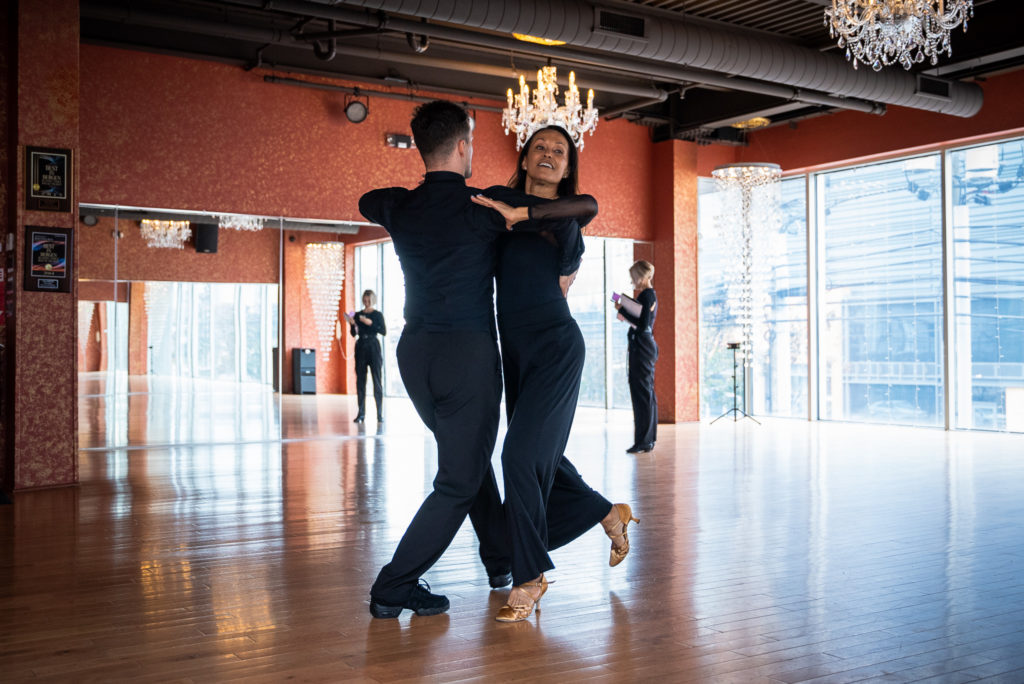
Before you move your feet, build the shape you’ll move in. In the waltz, your frame is how you and your partner communicate — not your hands, and definitely not your grip.
Posture (both partners):
- Stand tall with your weight over the balls of your feet, not the heels.
- Lift the sternum, drop the shoulders, keep the head level.
- Look past your partner’s right shoulder — never down at your feet.
- Engage the core lightly so your torso stays quiet while your legs move.
Closed position, leader:
- Right hand on the follower’s left shoulder blade, fingers together.
- Left hand raised to about the follower’s eye level, palm facing forward, holding the follower’s right hand lightly.
- Elbows lifted and forward, forming a soft, wide curve — think “toned,” not “locked.”
Closed position, follower:
- Left hand resting on the leader’s right upper arm, just under the shoulder.
- Right hand in the leader’s left hand, with a light, responsive pressure.
- Upper body slightly offset to the leader’s right so you aren’t stepping toe-to-toe.
The single most common frame error is squeezing. If your partner’s hand goes white, you’re gripping instead of connecting. A good frame feels like carrying something fragile between you — present, but never forceful.
Step 3: Dance the Waltz Box Step (the Basic Step)
The box step is the foundational waltz step. It’s called a box because your feet trace the four corners of a square on the floor. Two measures of music — six beats — complete one full box.
Leader’s box step footwork
| Count | Action | Foot | Technique cue |
| 1 | Forward | Left | Heel lead; body at its lowest |
| 2 | Side | Right | Begin to rise through the ankles |
| 3 | Close | Left to right | Fully risen; transfer weight |
| 4 (1) | Back | Right | Lower onto the ball, then the heel |
| 5 (2) | Side | Left | Rise again |
| 6 (3) | Close | Right to left | Fully risen; lower to restart |
Follower’s box step footwork
| Count | Action | Foot | Technique cue |
| 1 | Back | Right | Reach back through the toe, then lower |
| 2 | Side | Left | Begin to rise |
| 3 | Close | Right to left | Fully risen; transfer weight |
| 4 (1) | Forward | Left | Heel lead |
| 5 (2) | Side | Right | Rise |
| 6 (3) | Close | Left to right | Fully risen; lower to restart |
Say it as you dance it: “Forward, side, close — back, side, close.” The follower says the same thing starting from the back half.
Three details that separate a real box step from a shuffle:
- Steps 2 and 5 travel sideways, not diagonally. Move along the side of the box, not across it.
- On counts 3 and 6, your feet actually close. Ankles together, weight fully transferred. Half-closing is the most common reason a box drifts across the room.
- Keep the steps modest. Beginners take huge strides and lose balance. Your step length should never exceed what you can control with your own balance.
Step 4: Add Rise and Fall
Rise and fall is the gentle vertical swell that gives the waltz its floating, gliding quality. It’s what makes a waltz look like a dance instead of a walk in a circle.
Here’s the shape across one measure:
- Count 1 — lower. Knees softly bent, heel leading the step. This is your lowest point.
- Count 2 — rise. Straighten the legs and roll up through the foot.
- Count 3 — full height. You’re at your tallest, on the balls of the feet, with feet closed.
- Then lower again into the next count 1.
Instructors often summarize it as “down, up, up.”
The critical correction: the rise comes from lengthening your legs and rolling through your feet — not from bouncing your knees or lifting your shoulders. If your head visibly bobs, you’re bouncing. Cut the amount of rise in half and let the movement come from the ankles and the extension of the legs.
Don’t chase perfect rise and fall in your first week. Get the box step clean and even first, then layer this on top.
Step 5: Turn the Box (Your First Waltz Turn)
Once the box feels automatic, you turn it — this is how the waltz starts to travel and look elegant.
The left box turn (reverse turn):
- Dance the first half of the box (forward, side, close), but rotate about a quarter turn to the left as you step forward on count 1.
- Dance the second half of the box (back, side, close) with another quarter turn to the left.
- Repeat. Four half-boxes bring you through 360 degrees and back to where you started.
The turn is led by the body, not the arms. The leader rotates the whole torso and frame together; the follower stays connected and lets the rotation carry her. If you find yourself steering with your hands, you’ll feel the partnership break immediately.
Once the left box turn feels comfortable, the same principle produces a right box turn (natural turn) by rotating in the opposite direction.
Step 6: Travel with the Progressive Basic
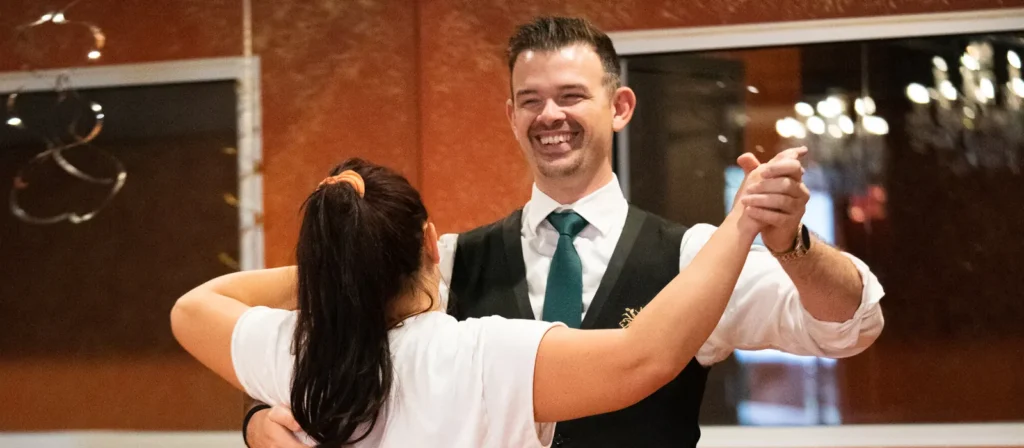
The box step keeps you in one spot. To actually move around a ballroom, you need the progressive basic — the same rhythm, but every step travels forward or backward along the line of dance (the counter-clockwise flow around the room).
Leader: forward left, forward-and-side right, close left — then continue forward with the right foot, side left, close right. Follower: the mirror image, traveling backward.
Two floorcraft rules once you’re moving:
- Travel counter-clockwise. Everyone on the floor moves the same direction; going against it is the ballroom equivalent of driving the wrong way.
- The leader is responsible for what’s behind the follower. Look ahead, shorten your steps in traffic, and use turns at the corners.
Step 7: Add Your First Variation, the Underarm Turn
The underarm turn is the first figure most beginners learn after the box, and it’s the one that makes the dance feel like dancing.
- From the first half of a box, the leader raises the left hand above the follower’s head.
- The follower walks forward — right, left, right, left, right, left — under the raised hand, traveling in a small circle over two measures (1-2-3, 1-2-3).
- Both partners rejoin in closed position and resume the box.
The follower keeps her own balance and walks; she isn’t spun. The leader offers a frame to travel around, not a handle to pull.
Other common beginner-level figures to add next: the change step, the hesitation step (used to pause and change direction), and the cross-body lead in American Smooth waltz.
Your First Month: A Practice Plan That Actually Works
Most guides stop at the steps. Here’s how to sequence them so the pieces stick — about 10–15 focused minutes a day beats one long weekend session.
| Week | Focus | Daily drill (10–15 min) | You’ll know it’s working when… |
| 1 | Timing + box step solo | Clap the “1” for 2 min, then box step alone, no music, then with music | You can start on count 1 without counting aloud |
| 2 | Frame + box with a partner | Box step in closed position at half speed | Neither partner is steering with their hands |
| 3 | Rise and fall + left box turn | Box with “down, up, up,” then quarter-turn each half box | Your head stops bobbing and the turn feels round |
| 4 | Progressive basic + underarm turn | Travel the room, add one underarm turn per song | You can dance a full 3-minute song without stopping |
A tip most beginners skip: practice the footwork without your partner first. Almost every “we can’t get this” problem in a couple is actually one person not knowing their own steps yet.
Common Waltz Mistakes (and the One-Line Fix for Each)
| Mistake | Why it happens | The fix |
| Looking down at your feet | Trying to check the pattern visually | Look past your partner’s right shoulder; trust the count |
| Bouncing up and down | Forcing rise and fall with the knees | Grow taller through the ankles and legs instead |
| Rushing count 3 | The feet want to close early | Let beat 3 finish completely before starting the next 1 |
| Death-gripping your partner’s hand | Nerves; trying to lead with the arms | Lead with the body; hands stay light |
| Steps too long | Trying to look sweeping and dramatic | Step only as far as you can stay balanced |
| Follower anticipating the step | Memorizing the pattern instead of following | Wait for the lead’s body movement — even a half-beat late is fine |
| Drifting across the room in the box | Feet never actually close on 3 and 6 | Bring the ankles fully together and transfer weight |
| Starting on the wrong beat | Not identifying the downbeat | Wait through a full measure and start on the next “1” |
Waltz Music: What to Practice To
Any song in 3/4 time at a slow-to-moderate tempo will work. If you can count “1-2-3, 1-2-3” comfortably through the whole song, you can waltz to it.
| Song | Artist / Composer | Feel |
| “Moon River” | Henry Mancini | Slow, classic, ideal first practice track |
| “Come Away with Me” | Norah Jones | Gentle and modern |
| “Tennessee Waltz” | Patti Page | The definitive American waltz standard |
| “Perfect” | Ed Sheeran | Modern, popular for wedding first dances |
| “The Blue Danube” | Johann Strauss II | Faster — better suited to Viennese waltz |
| “Emperor Waltz” | Johann Strauss II | Traditional ballroom, brisk tempo |
How to check a song yourself: play it and count “1-2-3” repeatedly. If the accented beat lands on your “1” every time, it’s a waltz. If you keep needing a fourth beat, it’s in 4/4 — that’s foxtrot or rumba territory instead.
The Waltz Styles You’ll Encounter
“Waltz” isn’t one dance — the version you learn depends on where you’re dancing and why.
- American Smooth Waltz — the most common social and studio style in the U.S. Partners can break apart for underarm turns and open figures, which makes it expressive and beginner-friendly.
- International Standard Waltz — danced exclusively in closed position, with strict technique. This is the competitive ballroom form.
- Viennese Waltz — much faster (around 180 BPM), built on continuous natural and reverse turns rather than a box step.
- Country Western Waltz — a relaxed progressive style danced around the perimeter of the floor to country music.
- Cross-Step Waltz — a social form popular in dance communities, built on a crossing step rather than a box.
For a full breakdown of tempo, frame, and technique differences, read our guide to the differences between waltz styles.
Waltz vs. Viennese Waltz: What’s the Difference?
Both are danced in 3/4 time, but they feel like different dances:
- Slow (standard) waltz is danced at roughly 84–90 BPM with pronounced rise and fall, longer steps, and time to shape each movement. It’s where every beginner should start.
- Viennese waltz runs at roughly 180 BPM, stays much flatter to the floor, and consists almost entirely of continuous rotation — natural turns, reverse turns, and change steps.
If you can waltz confidently, Viennese is a realistic next step. If you can’t yet, Viennese will simply feel like running in circles.
Learning at Home vs. Learning in a Class
You can absolutely learn the box step from a video — plenty of people do. Watch our instructors break down waltz technique on the Dance With Me YouTube channel and practice along at home.
What video can’t do is tell you why your box step feels off. Three things reliably require a second set of eyes:
- Frame feedback — you can’t see your own posture collapse, and a partner won’t know how to describe what feels wrong.
- Lead-and-follow calibration — leading too hard and following too early are invisible on camera and obvious to an instructor within ten seconds.
- Rise and fall — the difference between rising and bouncing is a matter of a few centimeters.
The practical approach most of our students take: learn the pattern at home, then bring it to a lesson so an instructor can fix the mechanics before they turn into habits. If you’re weighing your options among styles, our beginner ballroom dance guide explains which dances are easiest to start with and why the waltz usually tops the list.
Reading about the waltz is a great start, but nothing replaces learning the timing, frame, and rise and fall with a live instructor who can correct you in real time. Choose one of our studios below and find the best waltz dance classes near you at a Dance With Me studio — no partner and no experience required.
Frequently Asked Questions
What are the basic steps of the waltz? The basic step of the waltz is the box step: forward, side, close — then back, side, close, danced over six counts (1-2-3, 4-5-6). From there, the core beginner figures are the left box turn, the right box turn, the progressive basic, the underarm turn, and the hesitation step.
Is the waltz hard to learn? No — the waltz is widely considered the easiest ballroom dance for beginners. The tempo is slow, the count is a simple 1-2-3, and the box step can be learned in a single class. The part that takes longer is rise and fall, which usually feels natural after a few weeks of practice.
What is the 1-2-3 count in the waltz? Waltz music is in 3/4 time, meaning three beats per measure with a strong accent on beat 1. You take one step on each beat, counting “1-2-3, 1-2-3.” A full box step spans two measures, which is why it’s often counted “1-2-3, 4-5-6.”
How long does it take to learn to waltz? Most people can dance a recognizable box step within one lesson. Dancing comfortably through a full song socially — with turns and travel — typically takes about 4–8 weeks of regular practice or 6–10 private lessons. Competitive-level technique takes months to years.
What is the difference between waltz and Viennese waltz? Slow waltz is danced around 84–90 BPM with pronounced rise and fall and a box-step foundation. Viennese waltz is danced around 180 BPM, stays flatter to the floor, and is built on continuous natural and reverse turns rather than a box.
Can you waltz to any song? Only to songs in 3/4 time (or a 6/8 feel counted in threes). If you can count “1-2-3, 1-2-3” with the accent landing on your “1” throughout the song, you can waltz to it. Songs in 4/4 time call for a different dance, such as foxtrot or rumba.
Do you need a partner to learn the waltz? No. Group classes rotate partners, private lessons pair you with your instructor, and the footwork, timing, and rise and fall can all be practiced solo. Many students start alone and find practice partners through class.
Who leads in the waltz, and how does leading work? Traditionally the leader (historically the man, though roles are open at most studios today) initiates each figure. Leading happens through body movement and frame — a change of direction in the torso — not by pushing or pulling with the hands.
What is rise and fall in the waltz? Rise and fall is the gentle vertical motion through each measure: lowering on count 1, rising through counts 2 and 3, and lowering again for the next 1. It comes from extending the legs and rolling through the feet, not from bouncing the knees.
What shoes should I wear to waltz? Any shoe with a smooth sole that lets you pivot — leather-soled dress shoes work well. Avoid rubber soles, which grip the floor and can cause knee strain. Followers usually prefer a low, stable heel (1–2 inches) over a stiletto when starting out.
Is the waltz a good choice for a wedding first dance? Yes — it’s one of the most popular first dance choices because the timing is forgiving, the figures look elegant on camera, and a simple box step with one or two turns fills a full song beautifully. Many songs used for first dances are already in 3/4 time.
Can I learn to waltz from YouTube videos? You can learn the pattern from video, and it’s a great way to practice between lessons. What video can’t provide is feedback on your posture, frame, and lead-and-follow connection — the parts most beginners get wrong without realizing it.
Is the waltz good exercise? Yes. Waltzing is low-impact, continuous movement that builds balance, posture, and core stability, and partner dancing has been widely studied for its benefits to coordination, memory, and cognitive engagement.