The difference between mambo and salsa depends on timing, historical context, and the specific style you are learning. Ballroom mambo typically steps on counts 2-3-4 and 6-7-8, breaking direction on beats 2 and 6. Salsa can break On1 or On2, and New York-style salsa On2 is historically referred to as mambo—which explains why the names frequently overlap.
Both dances share musical roots and familiar partner movements. The clearest comparison separates when you step, when you change direction, and which specific tradition you are practicing.
Quick Comparison: Mambo vs. Salsa at a Glance
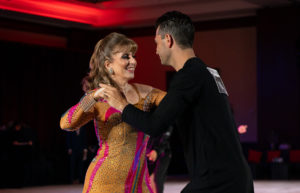
To help you identify the differences instantly, here is a breakdown of the three major timing traditions:
1. Ballroom Mambo (American Rhythm)
-
Basic Stepping Counts: Steps on 2, 3, 4 and 6, 7, 8 (holding counts 1 and 5).
-
Break Counts: Changes direction on beats 2 and 6.
-
Tempo / Music: Typically danced to fast, driving big-band tracks at 180 to 220+ BPM.
-
Teaching Context: Strict American Rhythm technique and defined competitive ballroom figures.
2. Eddie Torres Salsa On2 (“New York Style”)
-
Basic Stepping Counts: Steps on 1, 2, 3 and 5, 6, 7 (holding counts 4 and 8).
-
Break Counts: Changes direction on beats 2 and 6.
-
Tempo / Music: Danced to social salsa tracks ranging from 160 to 200 BPM.
-
Teaching Context: Social styles focusing on continuous cross-body leads and linear pathways.
3. Salsa On1 (“LA Style”)
-
Basic Stepping Counts: Steps on 1, 2, 3 and 5, 6, 7 (holding counts 4 and 8).
-
Break Counts: Changes direction on beats 1 and 5.
-
Tempo / Music: Standard social salsa tempos ranging from 150 to 200 BPM.
-
Teaching Context: A highly energetic social style utilizing a rapid 8-count syncopated phrase.
How Does Mambo Timing Differ From Salsa Timing?
While both dances respond to 8-count musical phrases, their beat accents differ. A “break step” changes your direction of movement. Ballroom mambo commonly breaks on counts 2 and 6, as does Eddie Torres salsa On2. However, their stepping counts are different. Eddie Torres On2 shares the 1-2-3, 5-6-7 stepping pattern of salsa On1, but places its breaks on different beats.
A held count means no new basic step, rather than a complete stop in body movement. Tracking a fast 8-count syncopated phrase requires keeping compact steps perfectly under your center of gravity.
Historical Context: Why Is Salsa On2 Sometimes Called Mambo?
Salsa On2 is frequently called mambo because New York-style salsa developed directly from earlier mambo traditions and retained a strict connection to breaking on the second beat.
-
The Mambo Explosion (1948): Cuban bandleader Dámaso Pérez Prado commercialized and popularized the Mambo sound, bringing hits like “Mambo No. 5” to the global stage before it spread to American ballrooms.
-
The Palladium Era (1947–1966): Located at 53rd Street and Broadway in Manhattan, the Palladium Ballroom became the undisputed epicenter of Mambo in New York City. The venue was famous for its weekly “Mambo vs. Salsa” showdowns featuring the “Big Three” Latin orchestra leaders: Tito Puente, Tito Rodríguez, and Machito.
-
Eddie Torres’ Standardization (Late 1970s): Legendary dancer Eddie Torres formalized the “New York Style Salsa On2” curriculum, bridging classic Palladium-era mambo break counts with modern salsa partnerwork.
“Mambo is not just a count; it is a direct conversation with the conga drum’s slap on beat two.” — Eddie Torres, Legendary Dance Instructor & “The Mambo King”
What Is the Difference Between Mambo and Salsa Music?

Classic mambo is associated with a driving big-band sound, layered percussion, and prominent brass and saxophone lines. The big-band mambo sound of the 1950s featured interweaving horn parts and incredible rhythmic energy.
The term Salsa was popularized by Fania Records in New York City during the 1970s as an umbrella marketing term for Cuban Son, Mambo, Cha-Cha-Chá, and Puerto Rican Bomba and Plena. Today, salsa music is defined by complex Afro-Cuban percussion, brass horns, and explosive tempos. Because salsa incorporates mambo among its musical influences, their repertoires overlap heavily.
How Do Mambo and Salsa Movements Compare?
Mambo and salsa both share rhythmic weight changes, deep partner communication, and expressive body movement. Ballroom mambo teaches those elements through strictly defined figures and technique.
Salsa movement is generally highly energetic, requiring quick weight transfers, intricate solo footwork (known as “shines”), and continuous cross-body leads. Salsa is explosive, dynamic, and packed with complex multi-spin combinations. Appearance alone is an unreliable way to identify either dance, as performance choices and training backgrounds affect what you see. Timing and teaching context provide a much clearer comparison than the number of turns.
Frequently Asked Questions (FAQ)
Are Mambo and Salsa On2 the Same Dance?
Sometimes the names describe the exact same social dance, particularly in New York-style salsa communities. Ballroom mambo, however, is a distinct American Rhythm dance. It uses different basic stepping counts from Eddie Torres salsa On2, even though both place their break steps on counts 2 and 6.
Can You Dance Salsa to Mambo Music?
Often, yes. Mambo and salsa share enough musical ground for dancers to use salsa steps with many mambo recordings. The track’s genre label does not, by itself, require you to dance On1 or On2.
Is Mambo Harder Than Salsa?
Neither dance is automatically harder for every beginner. Both require dancers to track a fast 8-count syncopated phrase. Your musical familiarity, previous training, the song’s tempo, and the instruction you receive all affect the learning process.
Explore Mambo and Salsa at Dance With Me
Understanding the counts gives you a starting point, but practicing them on a hardwood floor helps you truly feel the difference. Explore mambo and salsa lessons with Dance With Me Studios, and ask which timing each class teaches. Finding a local Dance With Me studio near you is the fastest way to choose instruction perfectly suited to your interests, experience, and dance goals.
Dance Studios in New York:
Dance Studios in New Jersey:
Dance Studios in Texas:
- Dance Studio in Austin
- Dance Studio in Southlake
- Dance Studio in Houston
- Dance Studio in The Woodlands
- Dance Studio in Fort Worth
Dance Studios in Georgia:
Dance Studios in Las Vegas:
Dance Studios in Connecticut:
Don’t see your city? Find a Dance With Me studio near you →